

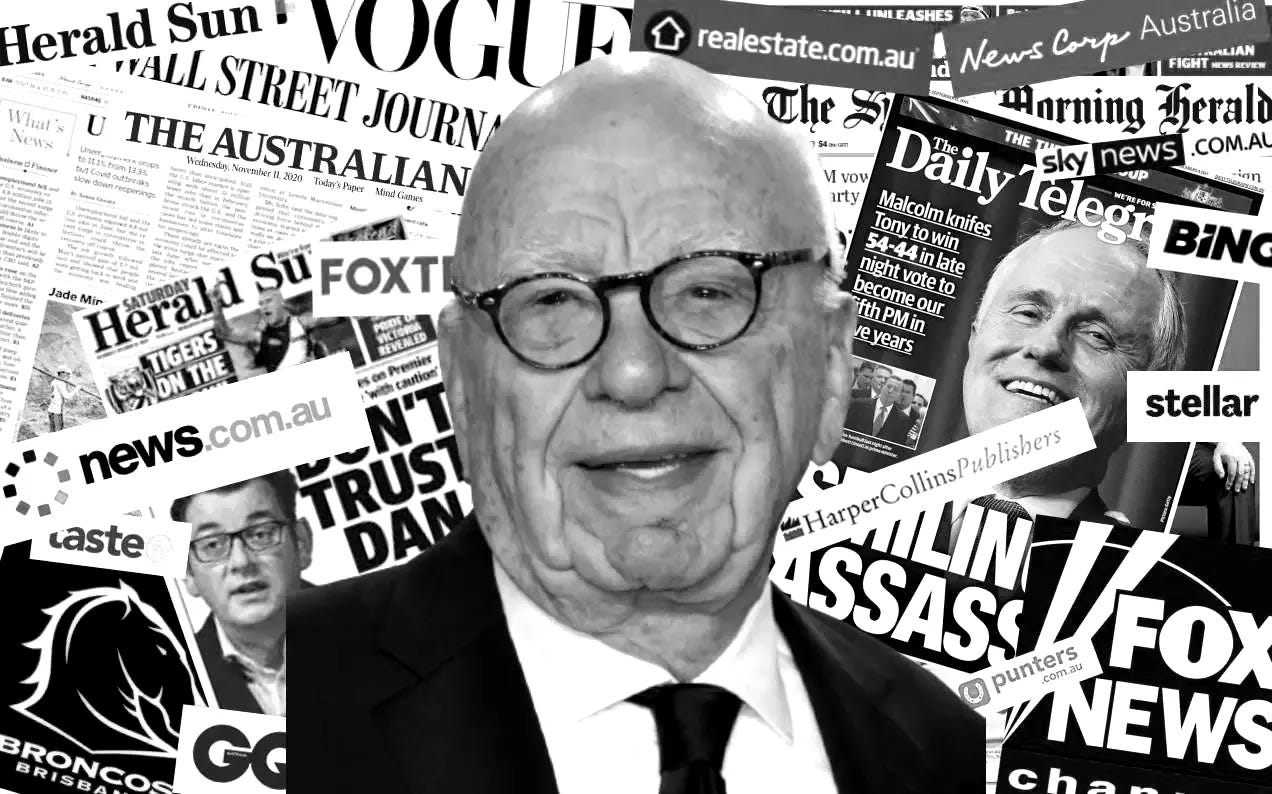
The Murdoch succession deal made headlines today. Who takes over, who steps aside, who holds the power at the world’s largest media conglomerate. It’s dramatic, but the real issue isn’t the family feud.
When one family’s inheritance squabble can shape how millions understand the world, the problem runs deeper. It’s not just about the Murdochs. It’s the fact that so much of the information economy is concentrated in so few hands.
That part rarely gets airtime because the companies responsible for telling the story are caught in the same web.
The bigger reality: America’s information infrastructure is concentrated, fragile, and often unreliable.
Which leaves a harder question: do executives, investors, and citizens actually have the information they need to make serious decisions? Or are we stumbling through a fog of consolidation, commercial pressure, and manufactured narratives?
Executives Don’t Trust the News. They Still Bet Billions on It.
Executives tell pollsters they don’t trust the media. Gallup puts overall trust at 31%, the lowest ever. Among leaders, the skepticism is just as strong.
But look at their habits. Most still read the same outlets every morning. They say the news shapes how they see markets, competitors, and risks. Social media barely registers for them.
A UK survey found that most executives make quick calls without checking the data.
More than half say they rely on instinct because real-time insight is hard to find. So they fall back on headlines and impressions.
That’s the bind. Leaders know the information is flawed, but they still use it to make decisions that move markets, jobs, and capital.
For strategy and intelligence teams, this is familiar terrain. They are often the last line of defense, asked to filter a noisy stream and deliver something a CEO can act on. The quality of that filter decides whether leadership sees signal or mirage.
When Ownership Tilts the News, Leaders Miss the Signal
Media concentration doesn’t just shrink the number of voices. It bends the signals that executives rely on.
Common owners, skewed headlines. A large-scale study tracked more than 100,000 outlet–company pairs. When the same big investors own >5% in both a news company and a rival of the firm being covered, tone turns negative. The same earnings report gets spun in opposite directions depending on who sits in the ownership web.
Fossil-fuel money in the stream. Major outlets sell sponsorships and custom content to oil and gas giants. The dollars flow into events and branded series that run alongside climate reporting. Executives trying to size transition risk see mixed signals—hard science on one page, glowing partner content on the next. Many delay capex or misprice risk. The bill shows up later in financing costs and supply chain retrofits.
Hollowed-out local desks. Hedge funds that roll up regional papers strip reporting to the studs. Coverage of zoning, ports, utilities, and labor markets dries up. Local operators miss early warnings. Manufacturers bet on the wrong sites. Banks lend into markets they no longer understand. The blind spots show up in write-downs and failed projects.
The pattern is clear. Who owns the outlet shapes what gets covered, how it’s framed, and what executives miss.
For the teams briefing boards and C-suites, the danger is subtle but costly: echo chambers created by ownership ties can slip unnoticed into “standard” coverage packs. What looks objective may be structurally tilted.
Treat “who pays” and “who owns” as part of your risk model. Map common owners across your top outlets. Separate sponsored content from independent reporting in your briefs. Pair national coverage with local primary sources. When the incentives behind the headline are visible, your decisions get sharper.
The Real Price Tag of Bad Information
We talk about misinformation like it’s a cultural nuisance. In reality, it’s a line item on the global balance sheet.
A University of Baltimore study tried to measure the damage. Their estimate: nearly $80 billion a year in losses. About half from market swings, the rest from poor decisions inside companies. Even that estimate is likely low.
Executives at leading enterprises are supposed to have the best advisors and data. Yet when signals are noisy or misleading, even experienced leaders fall back on instinct. They act on half-truths, trending stories, or headlines built for clicks. They overreact. They miss what matters.
This is not about patently “fake news.” The information economy rewards speed and engagement, not accuracy and context. Strategy requires patience. The media ecosystem punishes it.
Building a Better Information Diet
If leaders are swimming in polluted media water, the solution is filtration. Information itself isn’t scarce. Discipline is.
The best executives I’ve seen treat information quality like a core strategic asset. They don’t skim headlines and move on. They diversify their intake. They assign people to test the narrative. They check whether what “everyone knows” or what “many people are saying” is actually true.
Practical steps are simple, if unglamorous. Build systems that verify external claims before they shape strategy. Teach teams to spot cognitive traps—the belief that repetition equals truth, or that gut instinct can replace facts. Balance volume with depth. More data doesn’t mean better data.
Organizations that practice information hygiene avoid costly detours. They place cleaner bets. They stay steady while others chase noise.
This is where the sharpest research and intelligence teams earn their keep. They build systems that spot distortion early and surface the counterintuitive truth. The best ones not only insulate their executives from fog but also equip them to act faster when competitors are misled.
The Murdoch drama is a reminder of how much influence sits in so few hands. Succession inside one family shouldn’t ripple into the decisions of millions. Yet it does. The information economy is fragile, and executives can’t afford to take it at face value.
Clarity is not delivered. It’s built—one disciplined choice at a time.
If you run or support strategy, research, or intelligence inside your company, this is your fight every day. Share this with a colleague who has had to push back on “what everyone is saying” in order to get leaders to see what’s real.
Adil Husain is the founder of The Intelligence Council and Managing Director of Emerging Strategy. He’s spent over two decades in the trenches of global business, advising multinationals, building remote-first teams, and helping clients outmaneuver competitors across international markets.
Through The Intelligence Council, Adil is building what B2B media should have been all along: a platform that rewards clarity, calls bullshit when it sees it, and arms decision-makers with judgment they can use.
He writes The Husain Signal to test ideas, challenge conventional wisdom, and draw smart people into orbit.
If you want to connect, collaborate, or argue, you can reach him at adil@intelligencecouncil.com
Recent Articles
the first breath of air

It’s late August in northern New England: the day still thinks it’s summer, but the evening has already defected. The light hangs lower, sharper, golden. Even sound is thinner: no horns, no heavy machinery, just wind working a line of pines.
the breakthroughs we'll never have

Earlier this year, Zhongyuan “Kelvin” Wang, a sophomore at Brigham Young University in Utah, discovered a new family of origami patterns called bloom patterns. It sounds inconsequential until you understand what it enables: the ability to fold incredibly complex structures into compact forms and then deploy them into outer space with precision. NASA has…
business media is cooked

Last week, I wrote about why I had to build The Intelligence Council. A few readers asked the obvious follow-up: if the old media model is broken, what exactly killed it, and what survives in its place? Read on, for answers.