

We landed at Shanghai Pudong Airport on the 15th of August, 2006. As we entered Suzhou, we noticed fireworks going off directly ahead of us. We figured it must be a holiday. Neither my wife nor I knew the Chinese calendar well enough to guess which one. It seemed like a generous thing for a country to be doing on the evening you arrive in it for the first time.
They went off the next night too, and the night after that, and most nights for years afterwards.
It took me a while to figure out why. Families were setting off fireworks when they took possession of a new home, and the larger the home, the longer and more elaborate the display. So what I had driven into on my first night in the country, was people moving into new apartments, night after night, at a rate I could estimate from the noise.
I did not try to estimate. Instead I started a Facebook page called I Hate Firecrackers.
Why I Went
I had left Kaiser Associates that summer, a strategy firm in Washington, DC with BCG pedigree, where I had spent ~4 years and been promoted rapidly. The last engagement I managed was for the CEO and business unit heads of a Fortune 50 consumer goods company; the largest piece of work the firm had done at that point.
I was ready for a change.
I began interviewing for associate roles at a couple of private equity firms, chief of staff jobs, and within corporate strategy teams at large companies.
Going abroad was Roohi’s idea. She had worked in a couple of other countries and was teaching at an international school in Washington, and she was confident she could land a role overseas. Her proposal was exciting but reasonable: leave the United States for an adventure, with the option to return in a couple of years. I agreed on one condition, which was that we go to China.
The condition came from something I was seeing at work. Fortune 500 clients were coming to the firm with asks about China specifically and Asia generally, and the firm could not answer them. Neither could our strategy boutique competitors. Nobody had anyone on the ground, nobody understood how things actually got done there, and the work was either declined or delivered from a desk in the U.S. by people reading the same reports the client had already read. It was a gap I could see clearly.
The business I had in mind was not China-specific. It was an Asia play, emerging markets across the region, and I could have run it from Hong Kong or Singapore with better banking, a legal system I understood, and a considerably easier expat life. But I wanted to be inside the largest and most consequential market in the region rather than looking in from the edge of it. This had nothing to do with labor arbitrage. I was confident that large global enterprises were willing to pay a premium for actionable intelligence. What they could not find was someone able to tell them what was happening in that part of the world, in a language and delivery style they felt comfortable with.
I had never been to China. I did not know a single person there. My conviction rested entirely on a macroeconomic reading and on watching clients ask for something we could not credibly sell to them.

In preparation for the move we sold my beloved 1988 560SL and enrolled in Middlebury’s Chinese immersion program, a nine-week Summer bootcamp in Vermont, governed by a strict language pledge. It was a great decision. It gave us immediate survival speaking skills, the reading capabilities of a six-year old, and the beginning of an appreciation for Chinese culture.
Our families were very supportive of the move. Our friends were, perhaps more honestly, incredulous. “You’re an immigrant. You’ve made it in America. Why would you leave, to move to a third world country?”
Suzhou
Roohi received two international school job offers, one in Suzhou and one in Tianjin. Her job was to be our landing mechanism. It gave us visas and a roof over our head, and the plan was that I would use that runway to build something that could stand on its own.
I made three phone calls. Two were to James and Peter, close friends from Middlebury who had spent semesters in China, and one was to a friend of my father’s who had run operations for a hotel group there. The question I asked all three was narrow: proximity to Beijing, or Shanghai? All three had the same answer: Shanghai was the right bet for the kind of business I wanted to start. So we took Suzhou, because it was near Shanghai.
That is the whole of the analysis behind a decision that shaped the next decade. Two offers and three phone calls.
In November, we learned Roohi was pregnant. I had no clients and no revenue. I had been traveling to business hubs such as London, Singapore and Dubai from where Asia-related business operations were often run. While I hoped to drum up business, I had returned only with interest. My father-in-law, probably worried about his daughter, began forwarding me import-export deals he was coming across. I met a Canadian in Suzhou whose wife was a teacher at Roohi’s school. He had a potential sourcing deal in hand, and I had a business background and some Chinese language skills. We agreed to partner 50-50, and spent a couple of months bouncing around factories to source furniture for a large hotel project in Alberta. The relationship on the Alberta end didn’t convert.
I want to be accurate about this period rather than brave about it. I did not lose faith in the thesis. I did lose the ability to sleep.
The confirmation, which arrived from Washington, DC
Kaiser called in early 2007.
They had realized that having me in China let them credibly deliver work that was already coming in, and, more valuably, let them pitch work they would not otherwise have had the confidence to pitch. Sometimes I sat in front of the client as part of their team. Sometimes I worked behind the scenes. My income after expenses was comfortably ahead of what I had been paid as an employee.
So the first evidence that I was willing to see that my China bet would pay off, was a subcontracting arrangement with my former firm four thousand miles away.
Meanwhile, the fireworks had been going off outside my window every night for months.
My first hire was Martin Liu, who had been my Chinese tutor. He was in his mid-twenties, about to complete his master’s degree. His English was very good, and he struck me as resourceful in a way that is difficult to test for and obvious when you see it. I hired him as a research analyst, which understates what he did. He was also my personal and business “fixer.”
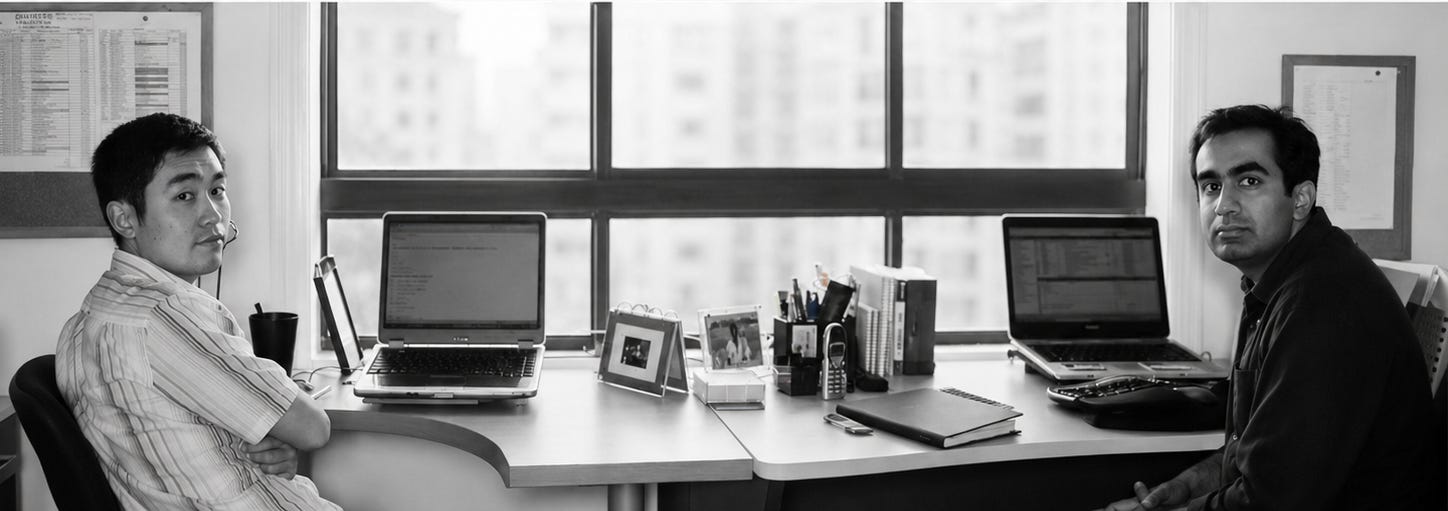
Martin and I worked out of my home for the first couple of months and then as business continued to accelerate and more clients came in, we subleased a three-bedroom apartment a ten minute bicycle ride away, in the building above Singha Plaza in Suzhou Industrial Park. This apartment felt luxuriously large despite our growing team of six analysts from six countries. It belonged to an Australian teacher at Roohi’s school who had moved in with his French-Canadian girlfriend. There were Singaporean and Malaysian restaurants downstairs and we ate in them most days. The industrial park itself was a joint venture between the Chinese and Singaporean governments. There was a plaque in Singha Plaza commemorating the park’s inauguration by Lee Kuan Yew.
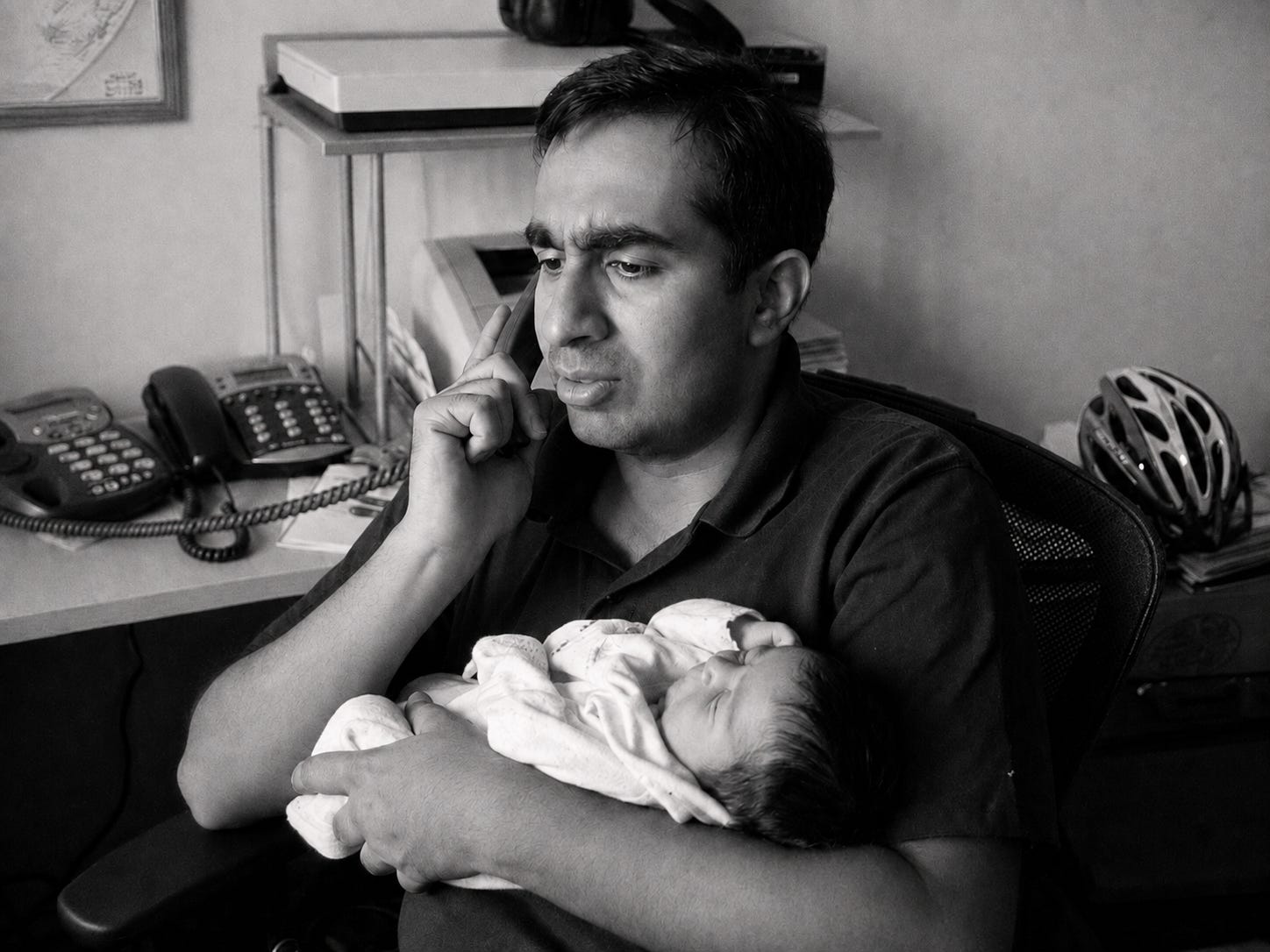
Sonia was born that summer, in Shanghai rather than Suzhou, because we were not confident in the hospitals near us and had found one in the city staffed by American-trained physicians. Our international insurance was still inside its exclusion period, so we paid for the delivery out of pocket. We drove in a day or two ahead of the scheduled cesarean and took a hotel across the street from the hospital. I was working twelve to eighteen hour days by then and I remember being at the desk in that hotel room late into the evening, reviewing decks that felt urgent and that I could not now name.
My original business idea had been quantitative, a way of modeling business sector risk and opportunity across China and East Asia. It may have been a better business idea than what I ended up doing, but it was unsellable in 2007 by a man with a monthly “nut” and no track record in that space. The strategy consulting skills I already had were immediately marketable though, and immediately credible. I was right about where and slightly wrong about what, which I have since come to think is the more common and more survivable way to be right.
Everything else I understood as weather. The first time I took the train from Suzhou to Shanghai it took three or four hours and I shared the carriage with live chickens. Some months later there was a ‘Z-train’ service that did it in forty minutes. Then, a bullet train ‘D-train’ in twenty-five. Then, a ‘G-train’ under twenty. I experienced this as my commute improving. When we arrived, Shanghai’s subway map had four lines and was something you could comfortably hold in your head; a decade later it had fourteen lines and was the largest system in the world. I experienced that as the city becoming easier to get around.
We moved to Shanghai in the summer of 2008, a brand new apartment on the thirtieth floor of a building in Laoximen, two hundred square meters, and walking distance to Xintiandi and my new office in Hong Kong Plaza on Huai Hai Zhong Lu. It was a fairly ordinary office building to begin with. Within a year or so they began redeveloping. The Ajisen Ramen place downstairs was replaced by a Cartier store. I recall missing the ramen.
The twenty-seventh floor
Sonia is in Shanghai as I write this, on a summer internship. She calls to report on the city and she is amazed by it. Boba delivered to her building by drone. Anything ordered online arriving in fifteen minutes, all the way up to the twenty-seventh floor. She describes it the way you describe a place that is running slightly ahead of the one you came from, with real delight, and I recognize the feeling precisely.
The circle you might like me to draw here is that she is seeing what I saw. I hope she is not. Delight and irritation are both consumer responses, and neither one is a reading. What I hope is that she gets past hers faster than I got past mine, and starts asking what the drone is evidence of.
I spent a decade in that country building a firm on the proposition that being inside a market lets you understand it, which is why I had chosen the mainland over Hong Kong in the first place. The real version of what I learned in the early months is narrower than that, and less flattering to me. Being present hands you the evidence. It does not compel you to read it. For months the biggest housing boom on earth announced itself over my head every night, and my response was to start a Facebook page.
I watch for this now in the businesses I get called in to advise. The markets they misread are rarely the ones they have stayed out of. They are the markets they have held for years, where their presence has quietly curdled into assumption, and insiders can no longer tell the difference between reading the place and having gotten used to it.
The bet I made in August 2006, which Roohi and I described to our families as a couple of years abroad, has paid out across two decades now, the most recent of which was an introduction that put my daughter in a Shanghai apartment this summer watching a drone come to drop off her boba.
Years later I described that decision to a mentor and told him I had been comfortable with the risk because I had no children and knew I could find work back in the States if the China bet came apart. That was an accurate description of August 2006. It was out of date by November. The fallback I had priced the entire thing against stopped existing about three months in. I had to figure out a way to make it work. The hedge came off before the business took off.
That is the part I leave out when people ask me how I knew.
Adil Husain is a competitive strategist who advises CEOs on how to compete and grow in contested markets. He is the Founder and Editor-in-Chief of business media company The Intelligence Council, and Managing Director of the global advisory firm Emerging Strategy. He has spent 25 years advising C-level executives at global companies on competitive strategy, market entry, and international growth, with on-the-ground experience across China, Southeast Asia, and major emerging markets.
You can reach him here for a conversation: ahusain@emerging-strategy.com