

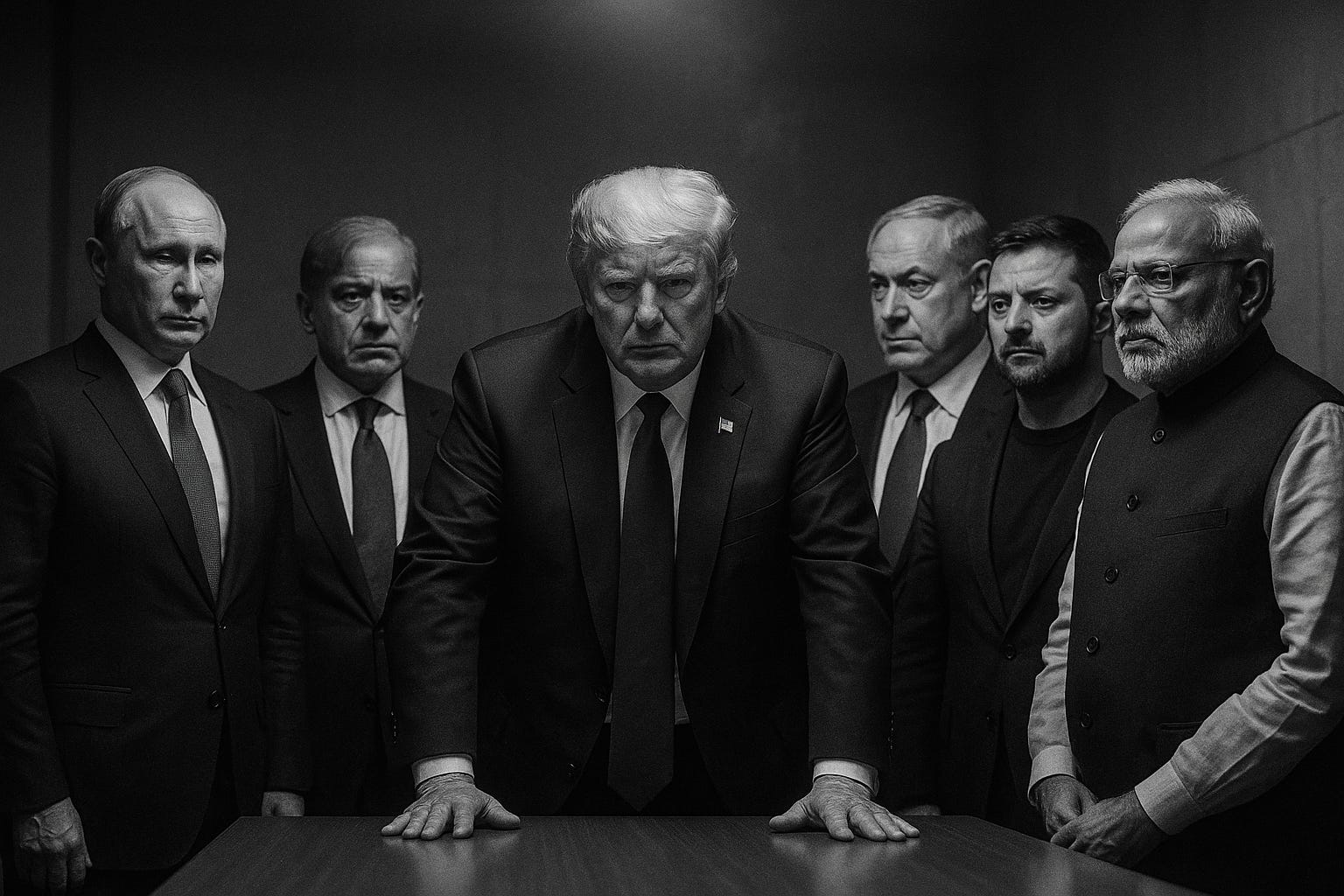
Three conflicts, one year, one dealmaker. In 2025, Donald Trump moved from the campaign trail to the negotiation table, claiming a peacemaker role in three major conflicts: Israel–Gaza, India–Pakistan, and Russia–Ukraine. Each case offered the same promise: that willpower and deal instinct could force peace where diplomacy had failed. For better or worse, Trump’s personal appetite for risk and visibility has brought the United States back to the center of conflicts. His pursuit of victory—whether strategic or reputational—reintroduced a kind of kinetic diplomacy absent from the Biden administration.
The final section applies the same logic forward, exploring how bargaining and game theory can still be used to engineer a ceasefire in Ukraine, the only major ongoing conflict Trump has yet to pause.
I demonstrate that these are not random outcomes but tests of structural power. Each case reveals how bargaining leverage actually functions when the United States tries to stop wars it did not start. The Gaza ceasefire happened because Washington controls what Israel cannot fight without. The India–Pakistan ceasefire happened because neither side wants a nuclear catastrophe but needed a referee, even if they denied it. The Russia–Ukraine ceasefire effort has failed so far because Moscow, the belligerent, does not face costs that only Washington can impose or remove. In each case, Trump’s willingness to act quickly and claim credit shifted the tempo of play: it compressed decision time for others and forced faster moves within games that had grown static under Biden.
What links these cases is bargaining power. When one actor controls another’s critical dependency, it can alter choices through coercion. When it cannot, diplomacy drifts. Regular readers of The Husain Signal know I’m about to lean on game theory to clarify the logic: states act according to the payoffs they expect from continued fighting versus settlement. Change those payoffs through aid, threat or pressure, and behavior shifts. Fail to change them, and war continues.
This is not about Donald Trump’s personality or style. It is about position. Yet Trump’s confidence in his own deal-making abilities admittedly affects how that position is used. The United States can impose an outcome in Gaza because it holds a structural veto over Israel’s ability to fight. It can create leverage in South Asia by stepping into the one role both sides need—a crisis stabilizer when neither can safely back down first. It has not moved Russia or Ukraine because both still believe time and attrition favor them.
Why Some Deals Stick and Others Collapse
Ceasefires are not moral achievements. They are transactions under pressure. States stop fighting when the expected costs of continuing exceed the value of what they might still gain. Everything else—summits, press statements, photo ops—follows from that calculation.
Bargaining theory offers a disciplined way to understand why some conflicts end and others persist. It starts with three recurring problems.
Information: Each side hides or exaggerates its strength, testing the other through violence. War becomes a costly signal of resolve. Mediation only works if the broker can alter what each side believes about the other’s endurance or limits.
Commitment: Agreements collapse when parties cannot credibly promise to uphold them after power shifts. A ceasefire with Hamas or a deal with Putin is unstable not because negotiators lack imagination, but because neither side believes the other will stick to it once conditions change. In bargaining theory, this is the most durable cause of war.
Control of alternatives: Leverage comes from shaping what each party can do if negotiations fail—their BATNA, or Best Alternative to a Negotiated Agreement. When the United States supplies the hardware, money, or security guarantee a combatant needs to survive, it can alter that alternative directly. When it cannot, its leverage fades.
These dynamics interact with domestic constraints. Leaders fight two battles at once: one across the table and another at home. A broker who understands these domestic pressures can either widen or narrow the space for agreement. Trump’s use of Netanyahu’s coalition politics in 2025 showed how domestic weakness can be converted into external leverage.
Finally, credibility matters more than neutrality. Classic diplomacy values impartial brokers, but in coercive bargaining, influence often flows from alignment. A state that shares a party’s strategic interests can press harder because its threats are believable and its rewards tangible.
Together, these factors produce three models of external influence.
When dependency is overwhelming and credible enforcement exists, outcomes can be imposed.
When both sides fear catastrophe but maintain autonomy, influence can be manufactured temporarily.
When commitment problems dominate and no enforceable dependency exists, external actors are marginalized.
The three 2025 crises illustrate each model in sequence.
Israel–Gaza: The Imposition Model
By October 2025, Israel’s two-year war in Gaza had reached political exhaustion. Thousands of casualties, international isolation, and mounting domestic unrest created a convergence of pressures that no Israeli government could sustain indefinitely. What finally stopped the fighting was not moral persuasion or diplomatic finesse but leverage.
Israel’s war machine runs on American oxygen. Every jet in its air force, every precision weapon, and nearly every maintenance protocol ties back to U.S. supply chains. Between 2023 and 2025, Washington transferred more than twenty billion dollars in arms, spares, and logistical support , in addition to priceless American diplomatic support. Remove that, and the Israeli Defense Forces would be grounded within weeks. In bargaining terms, this is absolute asymmetry. The United States controls the critical node, and Israel has no substitute.
Trump understood that structural fact, and after Israel’s attack on Qatar, he was finally prepared to use it. His ultimatum to Netanyahu was blunt: accept the phased ceasefire, or U.S. support would pause. The message worked because it was credible. Israel’s entire operational capability depends on that pipeline, and Netanyahu could not risk its interruption.
Domestic politics amplified this leverage. Netanyahu faced protests from hostage families and declining public patience with endless war. However his far-right coalition partners threatened to bolt at any hint of concession, leaving him trapped between opposing constituencies. Trump’s intervention reframed weakness as strategy. By calling Netanyahu “one of the toughest negotiators I’ve ever seen” and portraying the deal as an Israeli initiative backed by Washington, he gave the prime minister political cover to retreat without appearing to yield.
Trump’s pursuit of visible wins makes him more willing to use coercive leverage than Biden had been. His personal need for validation via a Nobel Prize align with the United States’ structural leverage in a way that accelerates decision-making. What looked like instinct was, in game-theory terms, a credible threat issued by a player unconstrained by caution. Trump’s personality activated existing U.S. bargaining power.
This is a textbook two-level game. External coercion becomes acceptable when it solves a domestic constraint. The Israeli leader needed a face-saving narrative; Trump supplied it. The result was a ceasefire accepted within forty-eight hours, with initial hostage exchanges and humanitarian corridors established soon after.
The Gaza case demonstrates what coercive bargaining looks like when dependency is total and threats are believable. No coalition diplomacy or international consensus could have produced that outcome. It required a broker who owned the lever and was finally willing to pull it. In that sense, the ceasefire was less a diplomatic success than a display of network control: the power that comes from sitting atop the supply chain of another state’s survival.
India–Pakistan: The Manufactured Leverage Model
The May 2025 Pahalgam crisis began as a familiar cycle of violence and retaliation. After a terrorist attack in Indian-administered Kashmir, New Delhi launched air and missile strikes on targets inside Pakistan. Islamabad responded with drones and ballistic fire, hitting Indian bases. Within four days, both countries were trading salvos across the Line of Control and beyond. It was the worst exchange since Kargil in 1999, fought under the shadow of nuclear parity and political pride.
Neither side wanted a full-scale war, yet neither could stand down unilaterally. This is the coordination trap that game theorists describe as a mutual fear equilibrium: both prefer de-escalation, but neither trusts the other to move first. Each fears that restraint will be exploited as weakness. India’s doctrine of “swift punitive response” and Pakistan’s reliance on nuclear deterrence create incentives to act first and hope the other blinks later.
The United States entered the picture only when those assumptions started to fail. Intelligence intercepts on May 9 suggested Pakistani movement of nuclear command personnel and heightened alert at airbases near Rawalpindi. At the same time, India’s deep strikes into Punjab hit facilities in proximity to Pakistan’s Strategic Plans Division (i.e., nuclear arms) sites. For Washington, the scenario was crossing a line.
Trump’s team responded with rapid crisis diplomacy. Vice President Vance called Prime Minister Modi. Secretary of State Rubio spoke repeatedly with Pakistan’s army chief and prime minister through the night. Both leaders were urged to claim victory and stop. By May 10, the firing had ceased.
The speed and informality of the intervention mattered. Trump’s readiness to engage directly, skip bureaucratic caution, and publicly claim credit changed how both sides read the game. Each saw a U.S. administration willing to act as both mediator and enforcer, altering the risk calculus just enough to halt escalation.
Pakistan publicly credited Trump’s “paramount role” in brokering the ceasefire. India denied any mediation at all. The truth lay somewhere between. The U.S. did not dictate terms as it did with Israel. It manufactured leverage out of thin air—using the shared fear of catastrophe as the coordinating signal that both sides needed but could not send to each other.
Pakistan accepted the narrative because it benefited from it. U.S. involvement offered face-saving cover for a weaker state under economic strain. India rejected the narrative because admitting external influence would contradict five decades of bilateral doctrine. Intelligence reporting and independent analysis suggested that India’s initial air losses, and uncertainty over Pakistan’s deployment of new Chinese-supplied technology added to New Delhi’s caution in continuing the conflict. Both governments acted on the same incentive: avoid escalation they could not control.
This was leverage by circumstance, not structure. The United States held little enduring control over resources or alliances. Its influence lasted only as long as the crisis threatened to spiral. Once the ceasefire stabilized, that leverage became weak. Neither side granted Washington ongoing diplomatic space. The episode shows how power can be borrowed from context—manufactured in a moment of risk—but cannot be sustained without dependency to anchor it.
Russia–Ukraine: The Struggle for Influence Model
By October 2025, Washington’s ability to shape outcomes in the Russia–Ukraine war has thinned, other than by unilaterally withdrawing support to its own ally, Ukraine.
The United States remains the largest external actor, but its leverage has decayed year by year. Sanctions have failed to cripple Russia. Aid has failed to restore Ukrainian momentum. Negotiations have stalled because the underlying logic of the war—commitment failure over Ukraine’s sovereignty and alignment—cannot be solved through pressure or diplomacy.
Russia has adapted. Trade rerouted to China, India, and the Gulf has insulated Moscow from Western economic pressure. Oil revenue flows through a shadow fleet of tankers. Industrial production has recovered through domestic mobilization and imports of Chinese components. Putin’s circle has concluded that sanctions could be endured indefinitely. The United States can raise costs but it cannot change preferences.
Ukraine, meanwhile, has remained dependent on external aid but politically unable to compromise. Every casualty, every missile strike has hardened the population’s resolve. No Ukrainian leader can trade territory for peace without destroying their own legitimacy. This created a structural bind. The broker that funded Ukraine’s survival cannot dictate its terms, and the adversary that drives the war can absorb punishment without conceding.
Trump’s approach—pausing and restarting military aid, staging summits with Putin, and publicly claiming “I can end this war in twenty-four hours”—illustrates the limits of coercion when neither party’s equilibrium can be shifted. Russia’s gains along the front, though minimal, reinforce its belief that time favors endurance. Ukraine’s incremental success in striking Russian infrastructure reinforces its belief that persistence can still yield victory. In game-theoretic terms, both sides see continued fighting as preferable to any available deal. No broker can alter that calculus without altering the facts on the battlefield.
In this case Trump’s personality has brought leaders back to the table, but structure still sets the limits. Unlike in Gaza or South Asia, there is no lever he can personally pull that would alter Russia’s or Ukraine’s payoff structure.
The United States faces a classic commitment problem with asymmetric stakes. Russia cannot credibly commit to honor Ukraine’s sovereignty in the future. Ukraine cannot credibly promise to remain neutral if given the chance to rearm. Every potential settlement carries the seeds of its own collapse. The absence of enforceable guarantees—military, economic, or political—means no agreement can be trusted once signed.
In this environment, there is a lack of leverage not because of diplomatic failure but from structural symmetry. The United States could threaten more sanctions or promise more aid, but neither side’s expectations changed enough to shift the payoffs of war. The Alaska summit and the future Budapest summit become symbolic exercises: demonstrations of engagement without real control. Washington remains central to the conversation but peripheral to the outcome.
If Washington genuinely wanted to push toward a ceasefire in the Russia–Ukraine war without forcing Kyiv into capitulation, it would have to operate with a clear understanding of the structural limits imposed by bargaining theory. In practice, that means engineering a bounded equilibrium—not a peace agreement that resolves the conflict, but a temporary stabilization that both sides can rationalize as consistent with their long-term interests.
A workable U.S.-brokered ceasefire in the Russia–Ukraine war would have to accept that neither side can be coerced into surrender, nor trusted to uphold sweeping commitments. The only feasible goal is a pause both sides can live with, because it preserves their core interests while deferring the issues they cannot resolve. That means designing a low-ambition ceasefire anchored in verifiable restraint, not political settlement. The line of contact would freeze roughly where it stands, monitored by a small international mission charged only with confirming that guns remain silent. Both sides would retain deterrent capabilities, and violations would trigger automatic reversals of any gains. The focus would shift from “ending the war” to “managing its temperature.”
For Washington, influence would come not from dominance but from conditional reciprocity. Russia would face a sliding scale of sanctions relief tied to demonstrable compliance, giving it immediate incentives to pause operations without rewarding conquest. Ukraine would receive fixed aid guarantees and reconstruction funding that activate only under a sustained ceasefire, converting restraint into material benefit. Security backing could come through an EU–U.S. compact rather than NATO accession—credible enough to deter renewed invasion but short of the red line that makes any agreement impossible.
The result would resemble a modern Korean armistice: indefinite, tense, and incomplete, yet stable enough to prevent collapse. It would neither vindicate Moscow nor humiliate Kyiv: a truce that buys time, limits risk, and preserves the possibility of a real peace when exhaustion finally outpaces ambition.
Extracting the Explanatory Variables
Across the three crises: Israel–Gaza, India–Pakistan, and Russia–Ukraine, the U.S. experienced three distinct outcomes: imposition, facilitation, and frustration. Each corresponds to a different configuration of bargaining variables that determine how influence operates under pressure. These are not moral distinctions, but structural. Who depends on whom, how credible future commitments appear, and how domestic and international incentives align, all decide whether diplomacy can shape outcomes or merely describe them.
Asymmetric dependency: Israel’s reliance on U.S. weapons, spare parts, and financing gives Washington a veto over its capacity to fight, creating enforceable leverage. Pakistan’s weaker position creates limited vulnerability but only within a crisis window, while Russia’s diversified trade and autarkic adaptations neutralize external coercion. Dependency asymmetry translates directly into bargaining power; once it disappears, influence reverts to persuasion.
Severity of commitment problems: i.e., whether parties can credibly commit to any post-conflict arrangement. In Israel–Gaza, both sides could be coerced into a temporary exchange of hostages and aid because future power relations were not existentially threatened. India and Pakistan could coordinate de-escalation because mutual deterrence remained intact. Russia–Ukraine, by contrast, involves incompatible commitments: each side believes survival depends on outcomes that, for now, the other cannot accept. No mediator can repair that structurally.
Other factors—domestic constraints, broker credibility and escalation thresholds—shape how leverage works but do not alter the hierarchy. Domestic politics can amplify or blunt pressure; bias can make a broker credible; nuclear risk can force cooperation. But these are contingent. The deeper variables are structural: material dependence and commitment viability. Together they explain why the U.S. could dictate in one case, improvise in another, and flounder in the third.
Adil Husain is the Publisher/Director of The Intelligence Council and Managing Director of Emerging Strategy. He’s spent over two decades in the trenches of global business, advising multinationals, building remote-first teams, and helping clients outmaneuver competitors across international markets.
Through The Intelligence Council, Adil is building what B2B media should have been all along: a platform that rewards clarity, calls bullshit when it sees it, and arms decision-makers with judgment they can use.
He writes The Husain Signal to test ideas, challenge conventional wisdom, and draw smart people into orbit.
If you want to connect, collaborate, or argue, you can reach him at adil@intelligencecouncil.com