

If we want the jobs of Chinese peasants, we’d better be ready to live like them
“We borrow money from Chinese peasants to buy the things those Chinese peasants make.”
— JD Vance, Vice President of the United States
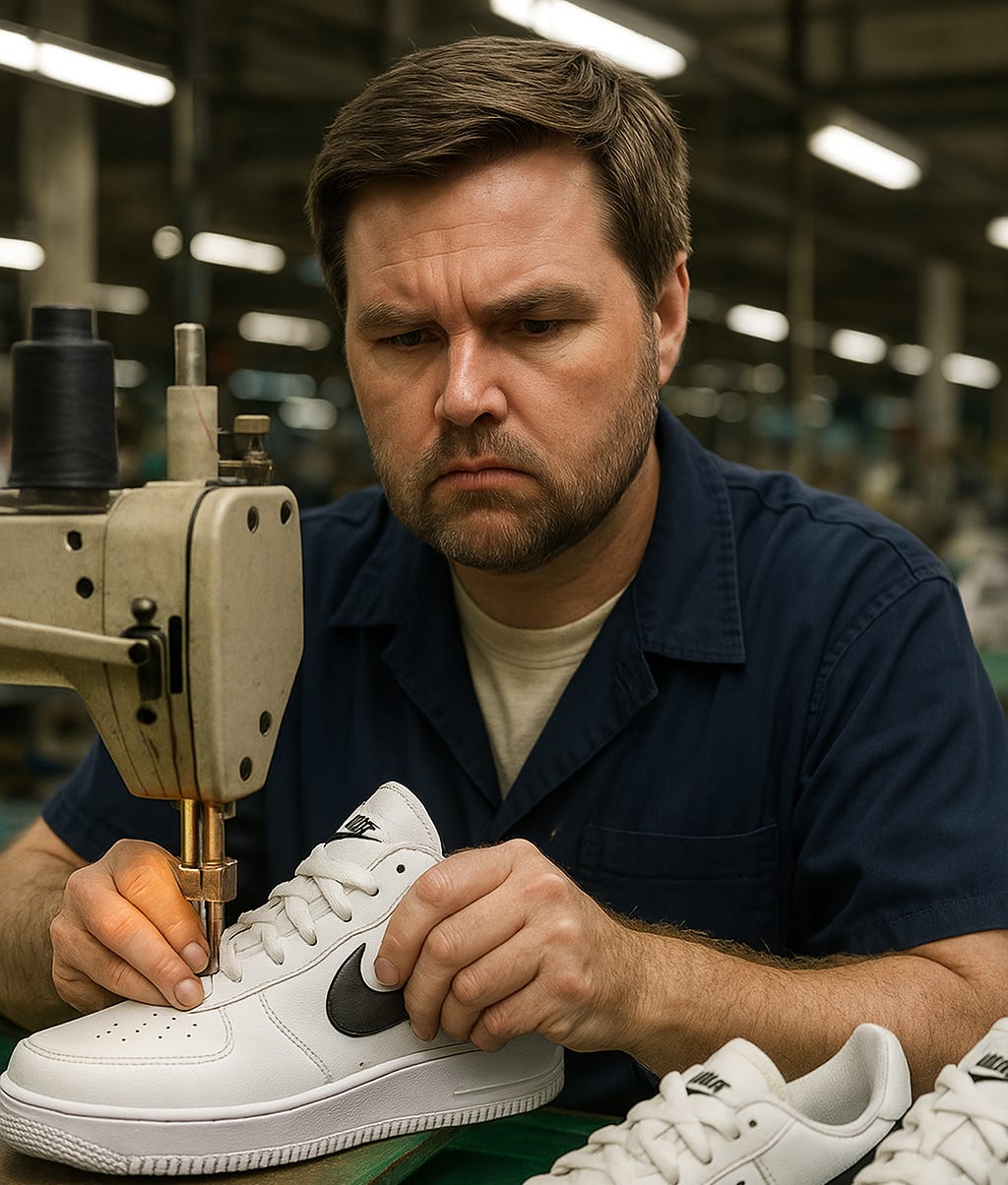
JD Vance inadvertently framed the real reshoring dilemma in a single sentence. The U.S. didn’t just offshore jobs. We offshored the lifestyle that comes with them.
And now? We want the jobs back—but not the life that made those jobs viable.
Let’s be blunt.
If Americans want to reclaim the jobs of Chinese peasants, they need to get used to the idea of living like Chinese peasants.
Or—we need a far smarter strategy.
Reshoring Is Not a Morality Play. It’s a Systems Design Problem.
We’re facing an economic identity crisis, not just a trade imbalance.
U.S. executives are being told to “bring manufacturing home.” The political class is dangling subsidies, slapping on tariffs, and spinning narratives about economic patriotism. But none of this answers the central question:
What, exactly, are we supposed to bring home—and at what cost?
Because let’s be clear:
We didn’t lose manufacturing. We exported the constraints of it.
Long hours
Low margins
Poor working conditions
Environmental externalities
And yes, minimal wages
We didn’t just ship out supply chains—we outsourced the social contract that came with industrialization.
I lived in China for a decade. Trust me, we don’t want all the externalities of producing every single widget in the U.S. and replacing China as the world’s factory. My family decided to move out of Shanghai in part because the air was too toxic to breathe (it took huge effort for the Chinese government to address those issues).
If we want to bring manufacturing back, we either:
Accept a dramatic recalibration of cost structures, productivity, and public expectations, or
Get smarter about what actually needs to come home.
I vote for the latter.
A Three-Tier Strategy for Strategic Reshoring
Let’s drop the all-or-nothing posturing and adopt a tiered framework grounded in economic logic, not nostalgia.
Here’s the strategy I’m recommending to clients at Emerging Strategy:
Tier 1: Onshore What’s Irreplaceable
Bring home what meets these conditions:
National security critical (e.g., semiconductors, medical inputs, advanced aerospace components)
High value-to-weight ratio (where logistics costs outweigh labor arbitrage)
Requires close integration with R&D
Can be heavily automated
Where speed-to-market creates competitive advantage
Examples: Fabless chip manufacturing, biotech fermentation, precision tools for defense, next-gen energy storage.
Why: These may be worth paying more for. In fact, the cost of not producing them domestically is geopolitical vulnerability. This part, the Trump administration gets right.
Tier 2: Nearshore What’s Valuable but Volatile
This is the middle ground—stuff that’s too risky to leave far away and in just one location (China), but too costly to make at home. Covid taught us the risks of relying on a single country. These are items where quality control concerns exist but are manageable, where production benefits from regional market responsiveness or those components where geopolitical risk exists but is moderated through friendly nation production.
Ideal for:
Automotive parts
Specialized machinery
Generic pharmaceuticals
Products tied to North American regulation or tax incentives
Think Mexico, Costa Rica, or even Vietnam and Eastern Europe—but not Michigan.
Why: This creates geographic diversification without sacrificing cost structure. It’s friend-shoring with a P&L.
Tier 3: Offshore What the Market Still Demands
Yes, some things should stay offshore. Because the market still demands ultra-low costs and tight margins, and it just isn’t going to work to produce those in the U.S. Not many workers in the U.S. are aspiring to stitch sneakers for Nike or turn the screws on assembling iPhones. We should continue to offshore labor-intensive production with limited automation potential, mature products, and products where specialized ecosystem advantages exist in offshore locations.
We’re talking:
Apparel and sneakers
Many consumer electronics
Home goods
Commodity components
Why: These don’t drive national advantage. They drive consumer price stability and retail margins. Move them and you’re guaranteed inflation, not resilience.
Tariffs and Industrial Policy: Tools, Not Theology
Let’s be honest—many current tariff proposals are about press releases and posturing.
What we need instead is an incentive architecture that matches the above tiers:
Subsidies and tax incentives for Tier 1 automation and workforce training. Baseline tariffs now, with incremental increases over the next 5 years, creating predictable cost curves for capital planning.
Duty-free trade corridors and infrastructure investment for Tier 2 nearshoring. Goods with USMCA content should qualify for lower tariff than the global baseline.
Zero tariffs, or if absolutely necessary, progressive consumption levies for Tier 3 to fund industrial reinvestment without inflating costs across the board.
Don’t just slap tariffs. Price in resilience.
Want a Resilient Economy? Build One.
We can’t executive-order our way to competitive advantage.
America’s future as a manufacturing nation will not come from bringing back the jobs of the past—but from designing the systems, skills, and strategies of the next industrial era.
This doesn’t mean we give up on manufacturing. It means we rethink our edge.
Because unless we want to live like the peasants we’re trying to outcompete, we’d better be damn sure we don’t try to outpeasant them.
We don’t need to win with brute force.
We need to win with strategy.
If you’re in manufacturing, this might be worth a read:

Adil Husain has over two decades of experience advising Fortune 1000 firms on strategy, market intelligence and global expansion. Having lived and worked in the U.S., and China for a decade each, he brings a unique perspective on how U.S. businesses can best succeed both domestically and internationally. Adil is the Managing Director of Emerging Strategy, a global strategic intelligence firm that helps mid-market and multinational companies navigate complex markets.
You can contact Adil here or connect with him on LinkedIn for more insights.