

There’s a kind of fatherhood that doesn’t announce itself. It doesn’t wrap love in language or offer lessons in real time. It moves instead in quiet gestures—a favorite meal prepared, a car payment covered, a warm glance that says more than words. I come from a line of such fathers. Men who led their families with steadiness and discipline, but rarely with speech.
Now I’m raising two daughters in a world neither my father nor grandfathers could have imagined—and I find myself talking more than all of them combined, even as I sometimes catch myself pulling back into the old, familiar silence.
This is an essay about three generations of fathers. About what we pass down without meaning to. About the space between what we feel and what we say. And the question that hovers in that space:
When is silence a form of respect—and when is it a missed opportunity?
That question has followed me for years. I heard it in my father’s pauses, in my own adolescence, and now—often—between the lines of my daughters’ voices. This isn’t a story of progress. It’s one of adaptation. One generation learning, and unlearning, the language of love.
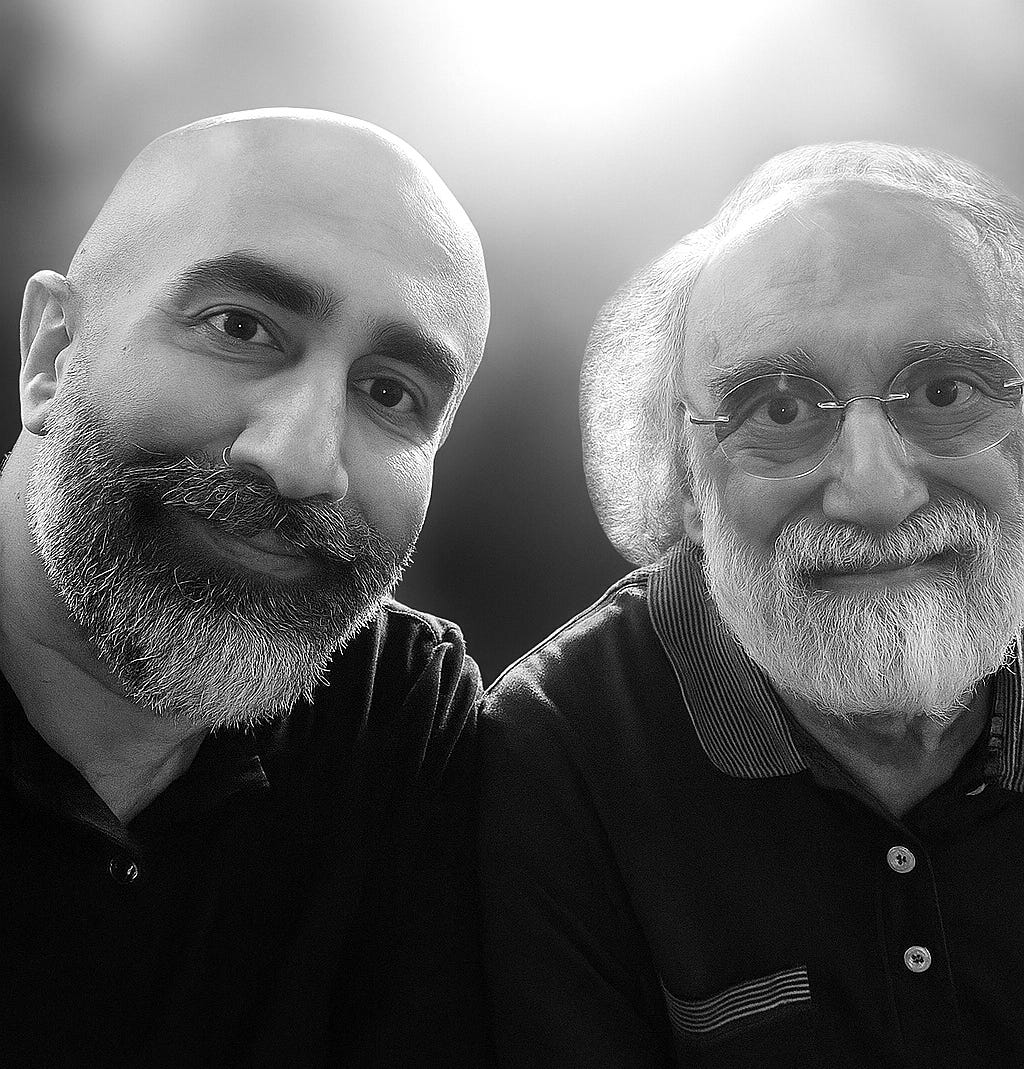
Inayat and Hashim: Love Without Language
My grandfathers, Inayat and Hashim, were men of few words. Not just in the performative way some men claim restraint, but in the way some men are built for it. Silence was not a strategy. It was a way of being.
They lived through the partition of British India and migration, raised families amid scarcity, and carried themselves with a quiet dignity that saw no virtue in asking for praise, or permission. “Soft-spoken” doesn’t quite capture it. There was softness, yes, but also gravity. They never raised their voices. They didn’t need to.
Love was not verbalized. It was assumed. So were expectations. Their authority was not explained or negotiated—it simply was. You did your part. You carried your weight. That was enough.
That model of fatherhood made sense in its time. A father’s role was to prepare you for a hard world, not to soften your journey through it. These fathers provided compass, not constant companionship.
There’s a certain reassurance in that: you knew where the lines were. But there was also a cost. Emotional ambiguity clung to the silence. The love was real—but you needed to read between the lines to see it.
Mukhtar: Respectful Space
My father, Mukhtar, inherited that restraint and softened it. He’s a gentle man—still is. He doesn’t impose. He doesn’t hold court. He creates space.
As a father, that instinct took the form of quiet guidance rather than directive authority.
He asked questions:
“What do you think is the right approach?”
“Are you sure that’s the best move?”
“Do you feel confident about your decision?”
Those were questions that signaled respect and trust. Faith in my judgment. And usually, that trust worked. I grew up feeling unburdened by control. I was free to choose, free to learn.
But there were times, especially in adolescence and early adulthood—when that freedom felt like drift. When I wanted him to speak plainly. To take a position. To say, without deferring to my autonomy, what he actually thought. I never doubted that he was in my corner. But sometimes it was hard to know what he actually believed.
Now, as a father myself, I understand how hard it is to know when to speak, and when to step back. Silence can feel like respect. But it can also feel like a lack of clarity. And it can take years to notice what was missing—something not withheld out of neglect, but out of love expressed in a quieter key.
Me: The Contradictory Voice
And now it’s me. A father to two daughters in a world where the terms have changed. The boundaries have blurred. The tone is looser, the stakes sometimes higher.
Sonia, my eldest, is leaving for Dartmouth this fall. She’s just now getting her driver’s license—a late bloomer in that sense, early in every other. She’s articulate, unafraid to correct me. Anya, younger, is harder to read. She carries a kind of emotional armor—guarded, private. Parenting her feels less like steering and more like knocking gently on a closed door, hoping she’ll let me in.
Both daughters speak with a directness that would have stunned my grandparents, and still startles my parents when they visit. They joke. They interrupt. They argue. They test the edges of love and still find themselves held.
And I let them—mostly. I want daughters who speak their minds, who believe their voice belongs in any room. That’s the ideal. But the world complicates the ideal.
And I ask them to be careful. I remind them, softly, repeatedly, that boldness comes with risk, especially for brown, immigrant girls with Muslim-sounding names, in today’s climate. I encourage voice while coaching restraint. I tell them to speak up, and to know when silence is wiser.
There’s no clean resolution to that contradiction. I live in it. Some days I push them forward. Some days I pull them back. I want them to take liberties I never dared—and I want to shield them from the consequences I know are still out there. Be visible, but safe. Be loud, but not reckless.
I say more than my father did. I explain more than my grandfathers would have imagined. And yet, in all my words, there are moments I feel less certain. More exposed. More vulnerable to getting it wrong.
What We Pass Down—and What We Don’t
Looking back, I see each generation not as a chapter in progress, but as a response to the last. My grandfathers taught through certainty. My father taught through space. I try to teach through dialogue, even contradiction.
But this isn’t a story of evolution. It’s not a neat arc of improvement. It’s a story of adaptation. What we’ve passed down isn’t a parenting method. It’s a set of values, refracted through time.
My grandfathers provided their children with discipline, dignity, endurance.
My father gave me trust, autonomy, and space to think for myself.
I try to give my daughters a voice, and permission to use it.
But I know they’ll find, in time, what I couldn’t give. Maybe they’ll wish I’d worried less. Maybe they’ll long for firmer lines. Maybe they’ll hear, in my careful phrasing, the same uncertainties I once felt.
That, too, is inheritance. Not just what’s handed down, but what’s left unsaid. The gaps. The contradictions. The unfinished thoughts that echo through generations.
Still, I don’t think any of us failed each other.
We give what we can, in the language we know, and in the time we’re given.
Happy Father’s Day.
Recent Articles:
the whisper you finally hear

There’s a certain kind of idea that doesn’t arrive with fanfare. It doesn’t announce itself as a bold new chapter or wrap itself in the language of reinvention. Instead, it hovers quietly in the background. It’s less a call to action than a shift in pressure. A whisper you keep hearing, until ignoring it takes more effort than following it.
the invitation that never comes

We were sitting around the room in Austin last week—eight men, all founders, all somewhere between forty and sixty. No one was trying to outshine anyone. That’s the quiet magic of our annual retreat.
the men who know me

There are eight of us. We’re founders. All men. All somewhere between forty and sixty. Scott is old. We keep reminding him. And for one week each year, we agree to be together.
Very authentic and relatable. Happy Father’s Day.
Very well written. I am trying to recall all that you have experienced and what you relate to. The three histories have the added dimension of geography which add to the variation in concepts of parenting. The small town in India, the elite education of Pakistan and the private schooling of the US, are all arranged in a ladder formation. We fathers adjusted well and the end product looks sellable!