

It’s late August in northern New England: the day still thinks it’s summer, but the evening has already defected. The light hangs lower, sharper, golden. Even sound is thinner: no horns, no heavy machinery, just wind working a line of pines.
In 1997, coming from Karachi to Middlebury, that first breath felt like unfamiliar grammar. Karachi’s air is dense, layered with heat, exhaust, and humanity. Vermont’s air carved space around me and demanded: what will you do with this? I didn’t have words for it then, only the disorienting certainty that the air itself was asking me to meet it halfway.
This week, nearly three decades later, my daughter arrived in Hanover to begin at Dartmouth. She’s not fresh off the boat in the way I was; she’s grown up as a global citizen, already fluent in American rhythms. But I’m sure that she, too, noticed that same cool outline around her shoulders, that pine-resin trace, that crisp metallic edge in the lungs. It’s a universal initiation for anyone arriving here at this moment in the season.
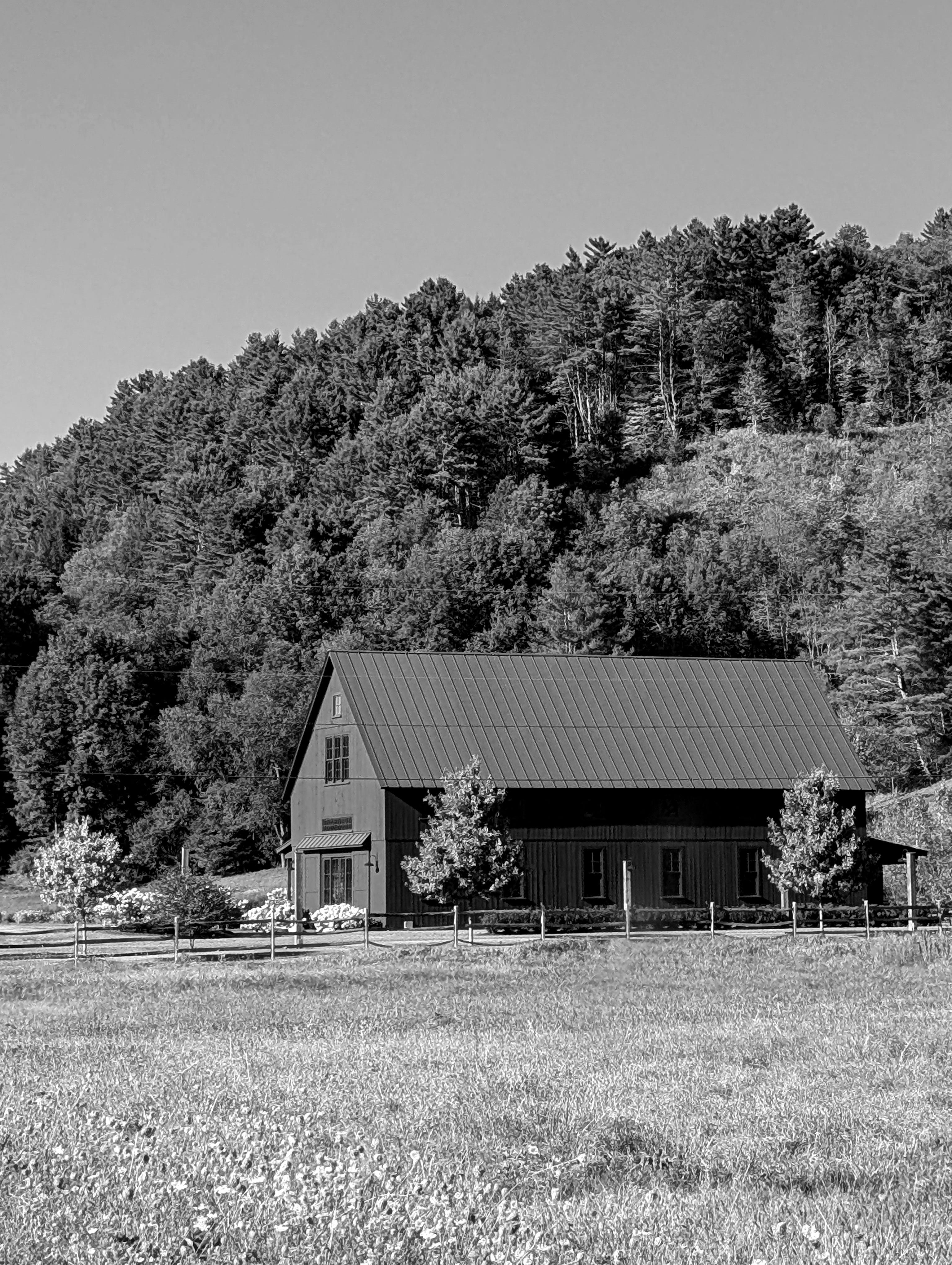
The Road In
Arrival to college towns in this region always happens by road. There’s no real shortcut unless you fly yourself in to a small airstrip on the edge of town. Otherwise, the speed drops, the cell signal weakens, and the landscape insists you adjust. Covered bridges, church steeples, white clapboard houses framed by mountains that rise in slow, heavy folds. The Green Mountains in Vermont, the Whites in New Hampshire. They anchor everything.
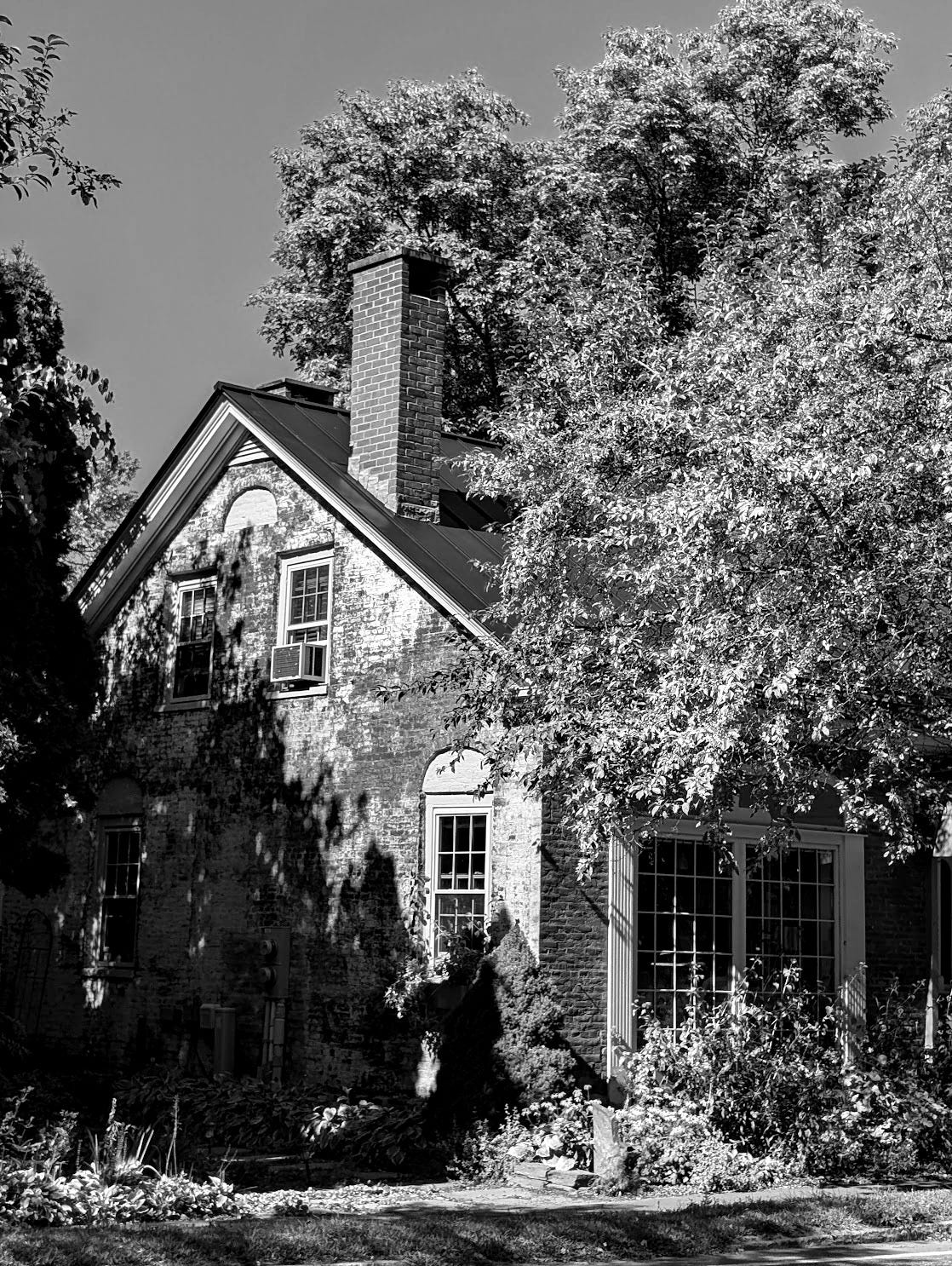
On this drive you also see the contrasts. You pass through towns like Woodstock, Vermont, that look like they were curated for postcards: the expansive greens, the immaculate inns, the bookstores and cafés and maple creemee stands where everything is arranged just so. Middlebury and Hanover carry the quality of a New England still life, framed as precisely as panes in a double-hung colonial window

But the same roads also take you through villages with boarded-up windows, faded paint curling off clapboards, yards scattered with rusting trucks and half-collapsed trailers. A flag that reads Trump for Vermont flies from a porch, not far from a weathered Bernie for Congress sticker on an early 90s Subaru. These contradictions sit side by side, stitched into the same landscape.
For an outsider, the beauty is overwhelming, but there can also be a subtext of unease. Driving a dirt road at night, trees closing in, GPS faltering, it’s impossible not to feel slightly out of place, even wary. The same qualities that make this region magnetic: the isolation, the silence, the tightness of its communities, can also make it feel impenetrable.
Yankee Gravity
Once you settle into town, the gravity of New England life shows itself. It’s the noon siren from the volunteer fire department, the chalkboard outside the general store announcing maple syrup for sale, the town green where kids play in the fading light.
Restraint is baked into the culture. The people are friendly, but warmth is rationed in the early stages of conversation. And the conversation is measured, practical, with a dry wit that surfaces only when you’ve proven you’re listening. The old shorthand for it is “Yankee frugality,” but it extends beyond money. It’s about words, gestures, even trust. Resources are not to be wasted.
Institutions here are plain but anchoring: general stores that have operated for centuries, where you can buy milk and eggs, hardware, and hand-knitted woolen hats, good for all seasons. Volunteer fire departments where half the town is on call, dropping whatever they’re doing when the siren sounds. I remember a classmate rushing out midsentence during a political philosophy seminar when his beeper sounded.
For an outsider, the gravity can be both reassuring and daunting. On one hand, the predictability and order of it feel solid, almost comforting. Beyond the tourist and college towns, that intimacy can sometimes feel less welcoming and more watchful. Everyone knows who belongs and who doesn’t. Walking into the store or driving down a dirt road to your Airbnb at night, you can feel equal parts welcomed and watched.
This quiet, deliberate culture pulls you in slowly. It teaches you to adjust your own pace, to speak less, and notice more.
The College as Outpost
Small colleges in northern New England don’t just sit within towns; they define them. Places like Middlebury and Dartmouth create a demographic inversion. A global mix of students, faculty, and visiting speakers layered on top of rural villages.
The colleges are cultural outposts that bring chamber music and international film festivals, Nobel Prize lectures and climate science conferences. They make viable the bookstores and cafés, and turn sleepy streets into seasonal currents of the young. The colleges with good town-gown relations draw in their neighbors to their cultural and cosmopolitan campus events and make these small college towns desirable places to live. A global conference at Dartmouth on the future of AI, in the place where AI itself was first imagined, might unfold just two blocks from a diner where the talk is unlikely to be about the latest technology.
These New England liberal arts colleges are islands; and the better ones are islands with bridges where the surrounding communities experience the wider world that passes through here. Yet the outpost feeling never fully disappears: you are always aware that you’re part of something both inside and outside the place.
The Meaning of Arrival
Arrival is never neutral. It carries awe and unease, beauty and dislocation. When I first stepped into Vermont as a teenager from Karachi, the clarity in the air and the blue of the late summer sky felt like an invitation but also a challenge: learn our rhythms, or remain a visitor. That challenge too is part of the education.
For my daughter, arriving in Hanover three decades later, the story is different but some parts may rhyme. She has already lived years in the U.S., already speaks 'American’ and its idioms, already knows the culture like a native. Yet northern New England is still a place apart, far from the familiar Washington D.C. suburb she’s called home for seven years. The sharpness of the evenings, the silence of gravel crunching on dirt roads, the postcard towns with struggle on the periphery. She will experience the place on her own terms. Over time, venturing beyond the postcard main street of her college town, she too will find beauty that is genuine and contradictions that are just as real. This is the start of her own chapter, set against a backdrop visually similar to mine, but written in a different time.
Adil Husain is the founder of The Intelligence Council and Managing Director of Emerging Strategy. He’s spent over two decades in the trenches of global business, advising multinationals, building remote-first teams, and helping clients outmaneuver competitors across markets they barely understand.
He writes The Husain Signal to test ideas, challenge conventional wisdom, and draw smart people into orbit.
If you want to connect, collaborate, or argue, you can reach him at adil@intelligencecouncil.com
Recent Articles
the breakthroughs we'll never have

Earlier this year, Zhongyuan “Kelvin” Wang, a sophomore at Brigham Young University in Utah, discovered a new family of origami patterns called bloom patterns. It sounds inconsequential until you understand what it enables: the ability to fold incredibly complex structures into compact forms and then deploy them into outer space with precision. NASA has…
operating in a low-trust world

Trust in institutions and organizations is often treated as an abstract measure: a number in a survey, a sentiment that fluctuates with news cycles. The past decade has shown it is anything but abstract. It is the barrier between disagreement and direct confrontation. Once that barrier weakens, the space fills with rumor, resentment, and people who beli…
the real american tradition

In a recent speech, Vice President JD Vance suggested that his job was to ensure a better life for people “in the country their grandparents built.”
This touched me. I remember your initial sentiments about Vermont, and now, three decades later, to see you write about Sonia’s beginning at Dartmouth feels like a circle completing itself. You’ve captured not only the air and atmosphere of New England, but also the essence of arrival and belonging. I couldn’t be prouder.