

There are eight of us. We’re founders. All men. All somewhere between forty and sixty. Scott is old. We keep reminding him. And for one week each year, we agree to be together.
It doesn’t sound like much. But every man reading this will understand how rare—how nearly impossible—that is.
We don’t call it a ritual. That would be too earnest. Too performative. But that’s what it is. An annual check-in that asks very little of us, except everything: our presence, our attention, our willingness to drop the armor we wear in the other fifty-one weeks.
This year, we’re meeting in Austin. It was supposed to be Costa Rica: swimming, ziplining, maybe a spiritual breakthrough in the jungle. But the logistics got the better of us. The issue was mine. And maybe that’s the subtext of these trips: we cover for each other, without making a thing of it. So we moved the week stateside. No one complained. We know what matters. It’s not the place. It’s the decision to gather.
There’s the Irishman, now a real estate developer in Bali, with the sharpest tongue and the softest heart. The Indian, quiet in manner, vast in enterprise, a tycoon of global apparel supply chains. The Chinese-American: five feet tall on a good day, a Harvard grad, a former lieutenant colonel, who has newly discovered the rhythm of tapping maple trees on a farm in rural New Hampshire as he plans his next venture. The Jewish-American New York lawyer turned medtech entrepreneur, who carries equal parts litigation and laughter. There is the native Shanghainese, a real-estate guy turned cross-border facilitator, contemplative, well-connected. The Persian-American from Palo Alto, a marketer with a philosopher’s soul, our gentle sage. The Dane, ever skeptical, ever precise. He sells marble furniture into Europe and runs a kebab shop empire across China. And then there’s me: Pakistan-born, Washington-based, the global business strategist. A benevolent dictator who keeps the trains running.
Over the last 16 years, the group has had additions and departures as lives evolved and locations changed. But each individual who has ever been in the group has the common thread of Shanghai-founder as DNA/origin story, and each has left their mark on the group, and shaped our collective story. I stepped out for 5 years from 2015-2020 and rejoined when the timing was right.
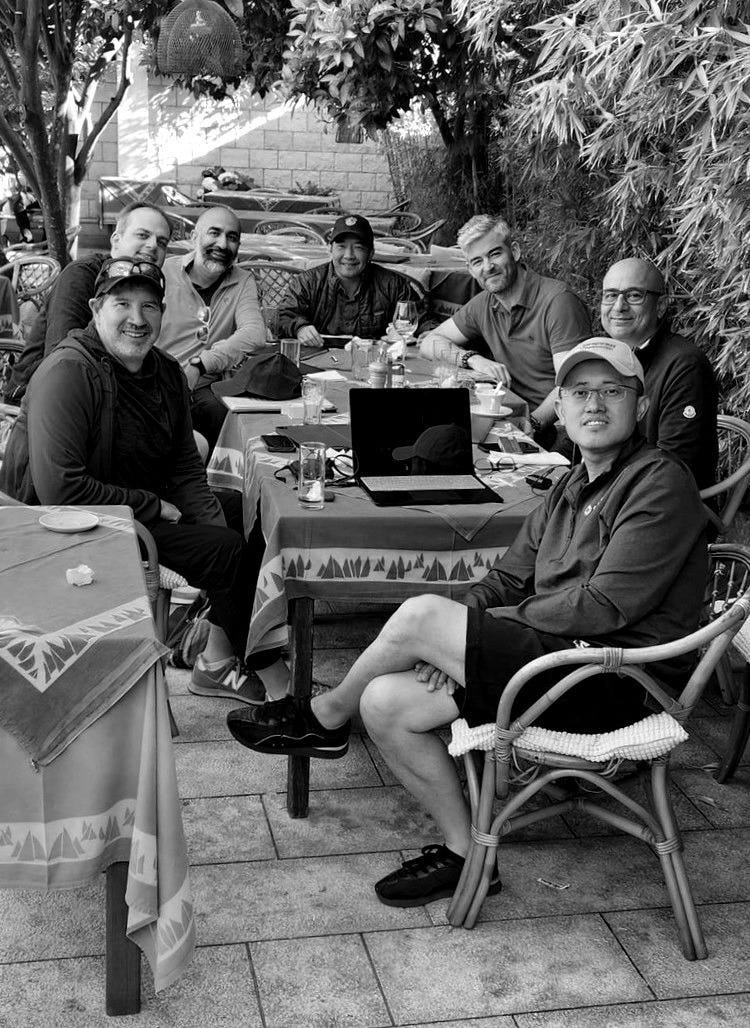
We met in Shanghai. Each of us arrived there in our own moment of ambition or transition, drawn by the centrifugal force that only a city like Shanghai exerts. Back then, we were younger, less polished, maybe more certain. Over time, we built companies, families, and in some cases, entirely new selves. A few stayed. Others scattered. But we built a habit: once a year, we come together.
The ritual outlasted the geography.
It’s tempting to romanticize it. To say we recharge or rediscover or relive something. That might be partly true. But mostly, what we do is maintain. This is maintenance work: on the friendships, yes, but also on ourselves.
Most men don’t have this. Especially founders. Our job is to project confidence, to perform vision, to make bets with our money and other people’s time. The role starts to blur with the person. Even casual conversations get freighted with posture or pitch. In that context, this trip becomes radical. Not because we change, but because we stop performing. No one’s raising a round. No one’s fixing a deck. No one’s quoting MRR in casual conversation. We unhook ourselves from all that.
And because we’re all in the same business, which is: building something from nothing, taking risk personally—we understand the weight without needing to describe it. You don’t have to explain a hard year, or a hard relationship, or what it feels like to have nowhere to hide. The context is already known. The language is shared, even when unsaid.
There’s a gravity to it. A quiet, yearly act that pulls us back to ourselves. When so much of our lives is consumed by motion—growth, scale, reinvention—this week offers continuity. A fixed point. The faces change slightly each year: a bit more grey, a bit more weathered, but the core remains.
There is also a kind of accountability embedded in it. Not to performance metrics or strategic goals, but to being known. These men remember versions of me I’ve started to forget. And still, they let me grow. There’s something quietly liberating in being witnessed without being frozen in time.
Male friendship at this stage of life is structurally unsupported. There are no default systems. Women often have circles, rituals, mechanisms of maintenance. We have calendars and inertia. Unless we build something ourselves, it simply doesn’t happen. That’s the real power of this week. We built it. We protect it. And that quiet, consistent decision may be one of the smartest I’ve ever made.
We don’t talk much about legacy. We don’t philosophize about aging. But it's there, low and steady, like a background hum you only notice when the room goes quiet. We’ve seen each other through growth spurts and downtimes, illness and grief, new chapters and false starts. And we keep showing up. That’s what makes it sacred.
There’s no photo album. Most years, we barely document a thing. That’s part of the point: no audience. Just the fact of it. A week carved out of time, stubbornly, gratefully, again and again. A lifeline with eight names on it.
Eight men. Together. Again.
And next year, if we’re lucky, again.
Adil Husain has over two decades of experience advising Fortune 1000 firms on strategy, market intelligence and global expansion. Having lived and worked in the U.S., and China for a decade each, he brings a unique perspective on how U.S. businesses can best succeed both domestically and internationally. Adil is the Managing Director of Emerging Strategy, a global strategic intelligence firm that helps enterprises navigate complex markets.
You can contact Adil here, subscribe to this newsletter, or connect with him on LinkedIn.
Really enjoyed reading this. Very well captures what groups of men-friends go through, if they are lucky to have stayed in contact.
Damn, Adil. So well written and so on point. Love this one:
Male friendship at this stage of life is structurally unsupported. There are no default systems. Women often have circles, rituals, mechanisms of maintenance. We have calendars and inertia. Unless we build something ourselves, it simply doesn’t happen.