

Every fall, right on cue with the new U.S. News rankings, the “fit” punditry floods feeds and parent nights with the same sermon. The “best fit” narrative has been spun into a cottage industry of books, keynotes, parent webinars, counselor trainings, and advisory work for universities that don’t “rank” highly and need to market their “fit.”
The pitch to high-achieving and ambitious college-bound students and their parents is: calm down, ignore prestige, and find your personal “fit.“
“Fit” gets framed as moral maturity, prestige as shallow status.
But the pundit class never has to bear the downside of that advice. If a student with the grades, test scores, and other credentials combining for a realistic shot at admission to a top 50 school picks the lesser known right “fit” instead, they bear the consequences of that decision, not the pundits who told them prestige is a vanity metric.
There’s also a sleight of hand in how “fit” gets sold. The stories are tidy: visit campuses, trust your gut, define your values. The real system is messy: aid asymmetries, yield games, and job recruiting pipelines that start from a short list of schools. “Fit” turns structural constraints into individual psychology. If you’re worried about ROI, you’re “chasing rank.” If you insist on options that actually unlock opportunity, you’re “obsessed.”
Let’s say we accept at face value the “best fit” pundits’ contention that some hidden gems offer equivalent or even superior undergraduate experiences compared to their better known peers. This essay is not about dismissing, in any way, shape, or form, the excellent overall education provided by hundreds of universities, and excellent specific programs offered by hundreds more. This essay is about the economics, data, and human behavior that not only cause the “best fit” narrative to ring hollow, but demonstrates how families are optimizing for what actually matters most: not the 4-year experience alone, but the 40 years that follow.
The fact is, students and their families are making rational choices in an irrational system. The pundit class keeps telling them to behave as if the system doesn’t exist. We’re going to do the opposite here: we’re going to describe the system as it is, and show why prestige functions as a risk hedge rather than a vanity play.

The hard economics families actually face
College in America isn’t a vibes purchase. It’s a multi-year capital allocation under uncertainty. Families optimize against three immovable facts:
Sticker parity across ranks
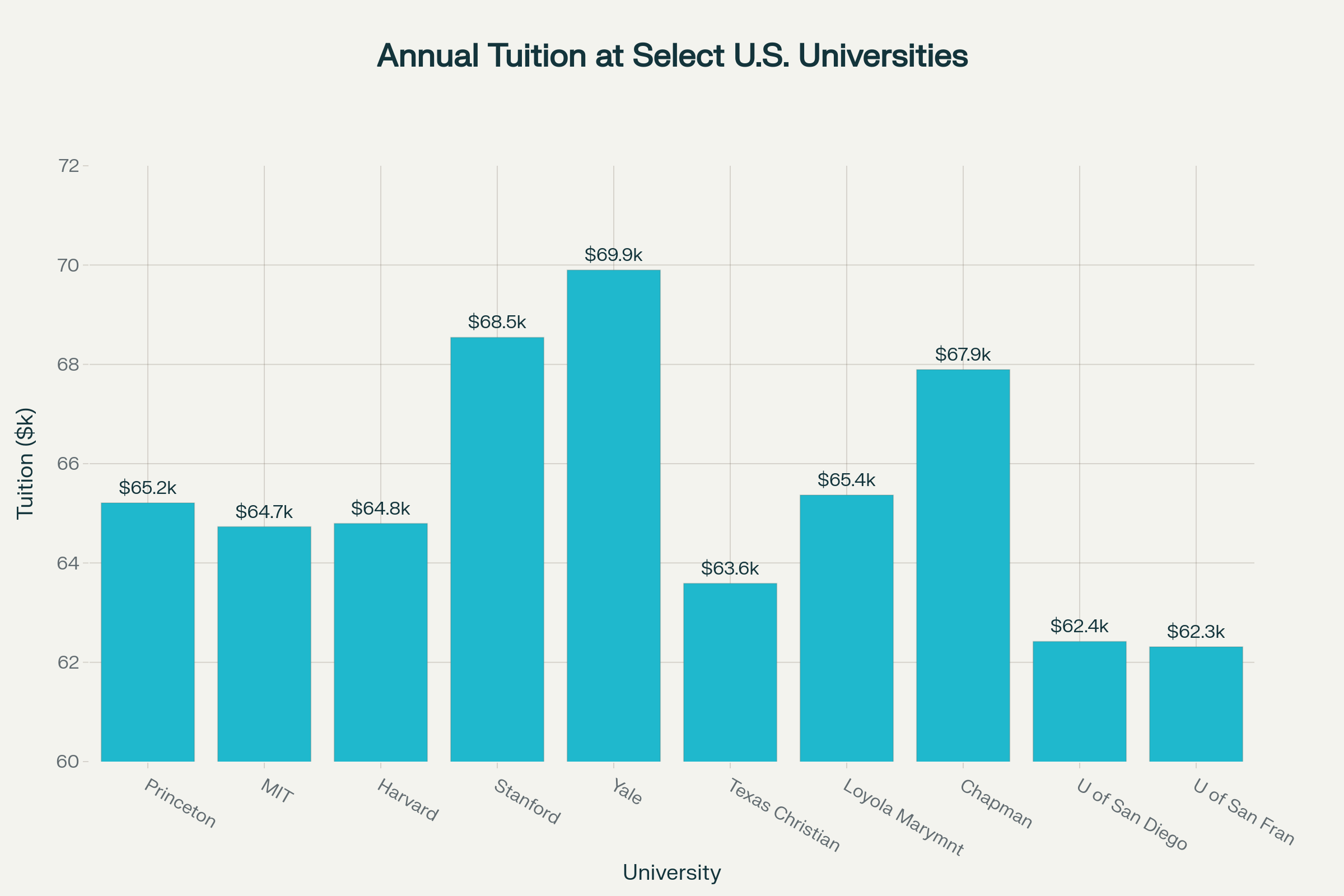
A #10 and a #100 private often post the same ~$60k–$70k tuition sticker. In most markets, less popular options would price more competitively to win customers so that supply and demand would converge. Not so in higher education. What exactly is the economic incentive for families to prioritize ‘lower-ranked’ institutions?
Cost is the net, not the sticker
That sameness is deceptive in opposite directions. At the top, big endowments and need-based aid slash prices for middle-income families. In the middle, thinner endowments + merit coupons keep the sticker high while the net stays high, too.
Free/near-free thresholds at the top (often sub-$100k–$150k income) don’t exist at many “hidden gems,” which lean on thin merit coupons. Debt outcomes reflect it: grads from the most selective schools are more likely to leave with little or no debt.
Translation: “less selective = cheaper” is often incorrect.
Prestige is an access engine—and an ROI hedge
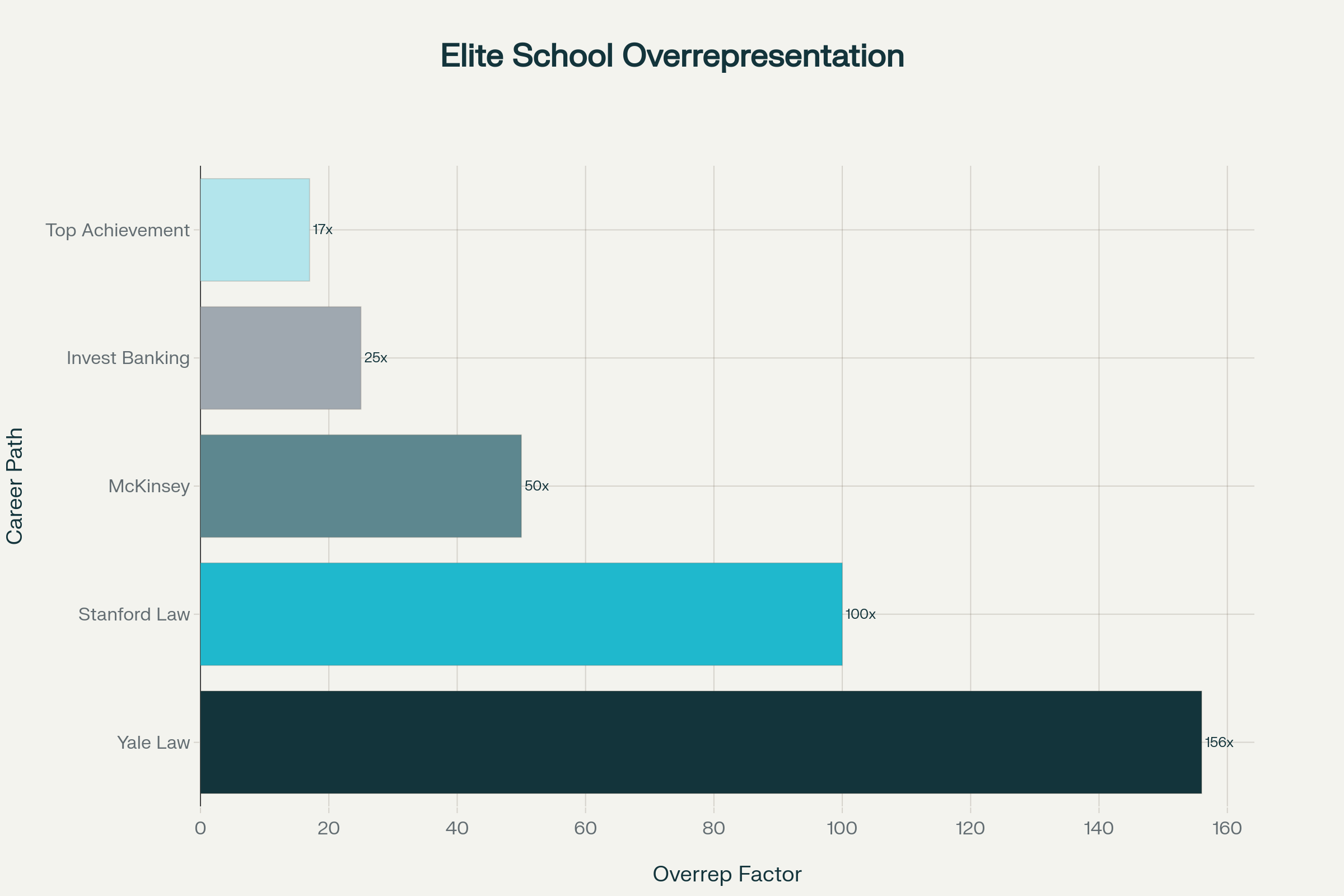
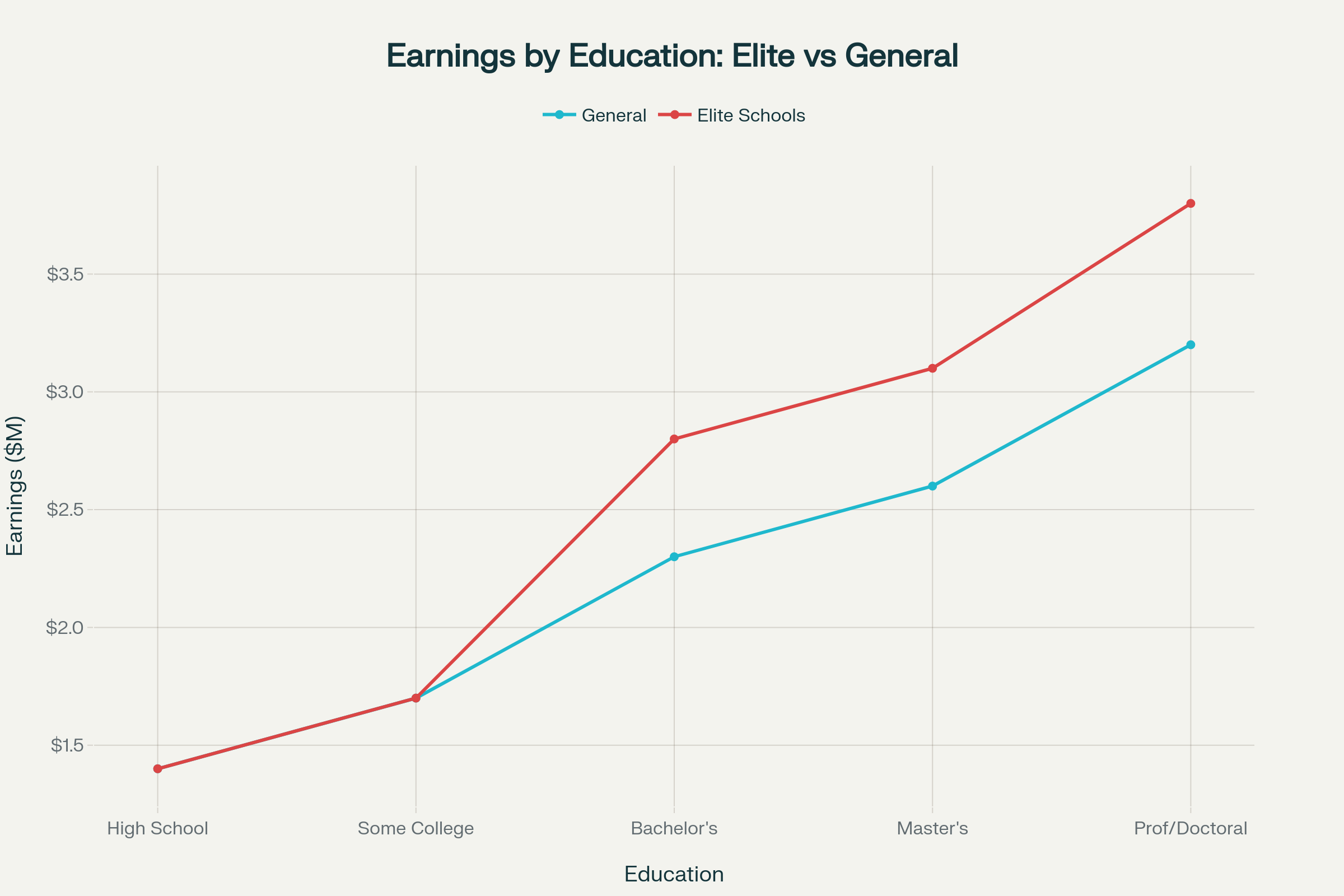
For students who aspire to significant upward mobility, and have the profile to support it, the funnel effects are real. Technology, consulting, Wall Street, T14 law, M7 MBAs, selective fellowships, and many PhD pipelines over-recruit from a short target list of colleges. Non-targets break in, but at lower rates and with more friction. Those early doors compound into better mid-career seats and pay. In a market that screens by credential, the brand also insures against credential inflation—when more jobs gate on degrees/pedigrees, the diploma reduces downside risk.
What rational behavior actually looks like
Families aren’t neurotic, foolishly chasing logos for ego; they’re optimizing under constraints and price-shopping for access and career outcomes. A clean decision model has four levers.
Prestige as a hedge
Families are prioritizing options that directly expand the student’s opportunity set. They use brand to insure against credential inflation and narrow recruiting funnels. The point isn’t just status for its own sake; it’s optionality over a 40-year career when many gates are labeled by pedigree. In a market that sorts by pedigree while hiding true prices, prestige often costs less and returns more.
Financial asymmetry
They price out net cost options, and this is where endowment depth matters. Elites with heavy need-based aid often beat mid-tiers on total cost and debt exposure; that changes the whole frontier of choices. If two options net within a band, the higher-prestige offer usually carries better downside protection and a larger, more responsive network.
Program specificity
Major, lab access, clinical/coop options, alumni connectivity, and internship density can swing outcomes inside any tier. A non-elite with a powerhouse program, clinical pipeline, or co-op model can be a great option. Rational families evaluate the actual opportunity set. That said, they also understand that a high-schooler’s interests may change over the course of undergraduate study. Some families hedge that risk by channeling away from schools that would not make their decision-set were it not for a very specific program.Fit as tiebreaker
Rational families treat “fit” as the final filter once risk, cost, and opportunity are within striking distance. Culture, geography, and vibe matter, but only after the economics and access are squared away.
This is a purely rational model: maximizing lifetime option value per dollar of net cost, and then letting “fit” sort equivalent contenders.
Punditry That Infantilizes Students and Parents
There are about 3,500 universities in the U.S. that fall into roughly 27 buckets: let’s say, a combination of Academic Rigor (high, average, low) X Study Body Size (large, medium, small) X Physical Setting (urban, suburban, rural). Assuming all buckets are equal in size, that’s about 130 institutions in each bucket.
A campus tour, reddit threads, and online research on classes, may lend prospective students a cursory understanding of institutional culture, but so much of each student’s own experience depends on personal factors: their roommates and friends, their specific classes and professors, the activities they get involved in.
Most students will be able to find a comfortable “fit” for themselves within dozens of different institutions within the larger bucket(s) they feel comfortable with. But the reason they prioritize the institutions that they do, optimizing for “prestige” within their range, is because they follow a more rational set of criteria than the “fit” pundits.
The “fit” script treats students and parents as dummies by telling them they are wrong to follow the rational economic considerations we have outlined in this article.
It pathologizes rational behavior. If you optimize for ROI and access, you’re “anxious” or “status-obsessed.”
It swaps economic models for mantras. “Fit” is a vibe word—conveniently undefined—so any result can be spun as success.
It absolves institutions. Aid asymmetry, feeder recruiting, and rankings manipulation are real.
Who are amongst the leading cultural purveyors of “fit?” This is not political—they span left, center and right. A few examples:
When David Brooks tried to pin college anxiety on ‘“elite overproduction,” I wrote at the time that he was missing the structural forces entirely. The same mistake shows up again in the “best fit” genre: pundits pathologize families instead of confronting the economics.
Bottom line: this particular wing of the punditry and college guidance industry offers families sermons and therapy rather than what they need: a clear-eyed model and data with which to make rational decisions. US News and similar college rankings media, elite colleges, and the pundit class are not going to reform this game. But the rest of us don’t have to play along.
Adil Husain is the founder of The Intelligence Council and Managing Director of Emerging Strategy. He’s spent over two decades in the trenches of global business, advising multinationals, building remote-first teams, and helping clients outmaneuver competitors across international markets.
Through The Intelligence Council, Adil is building what B2B media should have been all along: a platform that rewards clarity, calls bullshit when it sees it, and arms decision-makers with judgment they can use.
He writes The Husain Signal to test ideas, challenge conventional wisdom, and draw smart people into orbit.
If you want to connect, collaborate, or argue, you can reach him at adil@intelligencecouncil.com
Hey Adil, fellow elite grad and former debate team partner here with the opposing view.
The last decade has seen a significant shift for how students approach elite college admissions. Spend any time on Reddit or in affluent suburbs and it’s a lot different than when we applied to school.
I’m a fan of the pundits you mention and have read their requisite books. I do think one thing lost in Selingos book is how valuable a need based aid school can be for someone lacking funds. Many lower income students, like I was at Middlebury, went for practically free.
But many top students only index for prestige like it’s a handbag and other schools are lesser than which considering the flawed rankings is just wrong.
Yes if you want to work on Wall Street you’ll be best served at at Ivy which you probably won’t get into. And if you do your parents may mortgage the house to pay for it. And then comes the pressure for ROI. or you pay less to go to Baruch which also sends a lot of grads to Wall Street. Baruch isn’t better than Cornell but for a certain student it might be.
So many kids fall in love with the idea of a school then see it and it’s gone. Maybe after committing ED AND full pay. There’s no hedge against that other than alternatives. And good for the pundits for talking those up. The top 20 schools don’t need any more advocacy to drive more interest or students.