

January is when public office changes hands in the United States. New officials take their oaths. Some of those ceremonies include historic firsts. Predictably, attention follows the objects or sacred texts used at the moment of swearing in.
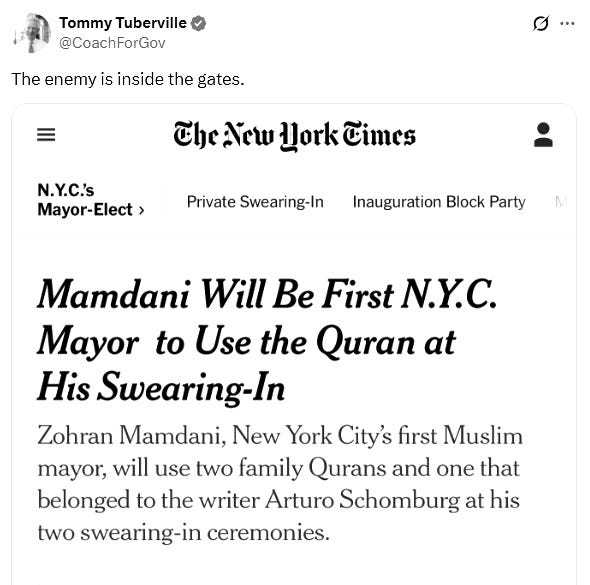
The oath of office is one of the few moments when the authority of the state is made explicit. Power is transferred. Obligation is formalized. The public is meant to understand, immediately and without interpretation, what has just occurred.
That moment answers a basic question every political system must answer plainly: to what is this person now bound?
In the American system, the answer has always been specific. Public officials are bound to the Constitution. The oath exists to make that allegiance visible and accountable. It does not exist to express personal belief, moral biography, or identity.
None of this excuses the bad faith of those who deliberately weaponize these moments. When some public figures turn a swearing-in ceremony into a loyalty scare, the fault lies with them. But civic norms cannot be designed around the hope that provocateurs will behave better. They have to be designed so their provocations fail.
What an Oath Fixes
An oath of office is a civic mechanism with a functional purpose. The Constitution requires an oath or an affirmation, and at the same time it prohibits religious tests for office. Those two provisions were paired deliberately. The system demands a binding commitment while refusing to condition legitimacy on belief.
This is not abstract theory. Article VI requires all federal and state officials to be bound by oath or affirmation to support the Constitution, while explicitly barring any religious test as a qualification for office. The presidential oath is the only one whose wording is fixed in the Constitution, and even there the text includes the option to swear or affirm. From the start, the obligation was mandatory; conscience was not.
That distinction matters because an oath fixes allegiance. It clarifies what an officeholder is obligated to uphold and what standards they will be judged against. It does not certify virtue or sincerity. Voters do that. The oath performs a different role. It converts private intent into public obligation.
Historically, this solved a real problem. Law cannot rely on continuous enforcement alone. Authority depends on commitments that are visible, acknowledged, and costly to violate. Oaths functioned as acts of self-binding, creating reputational, moral, and political consequences where coercion was impractical or undesirable.
That logic carried forward into constitutional government. During the revolutionary period, loyalty oaths were used to force clarity about political allegiance when authority itself was contested. The constitutional oath retains that function in a more stable form. It requires officeholders to declare, in public and without ambiguity, what they are bound to defend.
This is also why the distinction between swearing and affirming matters. The affirmation option was not an afterthought. It emerged from Quaker objections that oath-taking itself created a moral double standard. Affirmation preserved obligation while denying the state any claim over the soul.
Many religious traditions explicitly warn against confusing civic authority with ultimate allegiance to God; the American oath avoids that confusion by design. What it binds is public conduct, not inner life.
When that boundary is crossed, the function of the oath degrades. If the ceremony begins to communicate personal belief or identity, it stops doing the job it was designed to do. Allegiance becomes interpretive. Obligation recedes behind symbolism. The public is left to infer meaning where none should be required.
A civic oath works only if the signal is shared. The moment it is asked to carry private meaning, it loses clarity. The Constitution already resolved this problem. It demands allegiance without probing conscience. The oath is meant to be uniform in obligation, not expressive in form.
How the Ceremony Drifted
The Constitution specifies the obligation and the object of allegiance, but it says almost nothing about ceremony. Over time, custom filled the gap. Gestures and props were added to underscore seriousness and focus attention at the moment authority was assumed. A raised hand. A book beneath the palm. Familiar words delivered in a formal setting. None of this is legally required. It was meant to reinforce gravity, not to add meaning.
As the original purpose of these elements faded, their role shifted. What began as reinforcement slowly acquired independent significance. The presence of a particular sacred text came to be treated as expressive rather than incidental.
Historically, the gestures were pragmatic. Raising the right hand originated as a way to show it bore no criminal brand, a literal credibility check in early courts. Placing a hand on a sacred text functioned as a form of self-condemnation: to lie while touching the text was to render it spiritually useless to the oath-breaker. These were technologies of accountability in a world with weak enforcement and shared religious belief.
In a relatively homogeneous society, any forgetting of those meanings caused little friction. Shared assumptions carried the signal forward. In the United States as it actually exists, the same symbols now do something else. They invite interpretation. They sort. They provoke questions about belonging that the oath itself is not authorized to answer.
Even American history includes legally valid departures from the use of religious texts in oath-taking. Theodore Roosevelt took the presidential oath in 1901 without any book at all. John Quincy Adams took his oath in 1825 on a volume of law containing the Constitution, explicitly rejecting religious symbolism. Members of Congress are sworn in en masse with no objects whatsoever. Ambassador Suzi LeVine used a Kindle displaying the 19th Amendment. Representative Robert Garcia used a Superman comic alongside his citizenship papers and a family photograph.
In Confucian tradition, ritual is expected to shape virtue and identity. In the American system, the ritual was deliberately stripped of that purpose.
From Plato onward, political order has depended on symbolic compression. The American departure was to place that weight on a written constitution rather than on myth or sacred story.
The problem, then, is not pluralism. The Constitution already settled pluralism by separating allegiance from belief. The problem is that a ritual meant to compress meaning into a single, legible signal has been asked to carry private narratives.
When that happens, the oath loses clarity precisely where clarity matters most.
Why the Constitution Should be the Only Object
I keep returning to a simple conclusion: the only defensible national norm is a civic oath delivered on the U.S. Constitution, and on the relevant state constitution for state and local office. Not because other texts are unworthy, and not because faith must be hidden, but because the state has no business staging these declarations.
The United States permits wide variation in how oaths are administered, but the obligation attaches to the oath itself, not to any sacred text involved in the ceremony. That flexibility made sense when symbolism remained secondary. It becomes a problem when the symbol overtakes the signal.
A system confident in its legitimacy does not need ritual to secure loyalty. As the Stoics understood, duty holds whether or not anyone is watching.
Across traditions, political systems struggle with fears of divided loyalty. The American solution was not to adjudicate belief, but to refuse to symbolize it at all. Officials may swear or affirm. Belief is protected. Religious tests are prohibited. Nothing more is needed.
The oath of office is not a forum for self-definition. It is a public-facing verification that authority has been assumed under a specific legal order. Its purpose is not to reveal who the officeholder is, but to make unmistakable what binds them.
Under this norm, belief remains private and unconstrained. Per the First Amendment, faith is neither erased nor elevated by the government. What changes is the signal. The ceremony communicates one thing and one thing only: that authority is being exercised under a constitutional framework that applies equally to all.
John Quincy Adams understood this when he took his oath on the Constitution in 1825. It was clarity about allegiance, not a statement about belief.
In a country defined by disagreement, the oath should be the moment when interpretation stops. The Constitution is the common object because it is the common commitment. It is how a plural republic stays intelligible to itself.
Author’s Note
The argument may echo conservative instincts about restraint, but it does not defend any religious text as a default public identity. Likewise, some progressive readers may object to its refusal to center visibility or symbolic representation. I argue for no symbol at all beyond the Constitution.
The claim here is narrow. Our civic norms should adapt so that, in these very specific settings, we say less about who we are as individuals and more clearly about what binds us.
Adil Husain is a founder, strategist, and writer focused on power, institutions, and decision-making in complex systems. He advises senior leaders on competitive strategy, global markets, and organizational judgment, and writes The Husain Signal to think in public.
If you want to connect, collaborate, or argue, you can reach him at director@intelligencecouncil.com
100% agree.