

Plenty of strong market positions are actually mandates: a rule, a designation, a requirement somebody else wrote. They look identical on a P&L but behave very differently when the rule changes. Three organizations found this out, in 2010, in 2011, and over the course of a single night in 2021. A fourth, the American Bar Association, is finding out this week in a hearing room in Washington. It’s worth knowing whether your business runs on the same exposure.
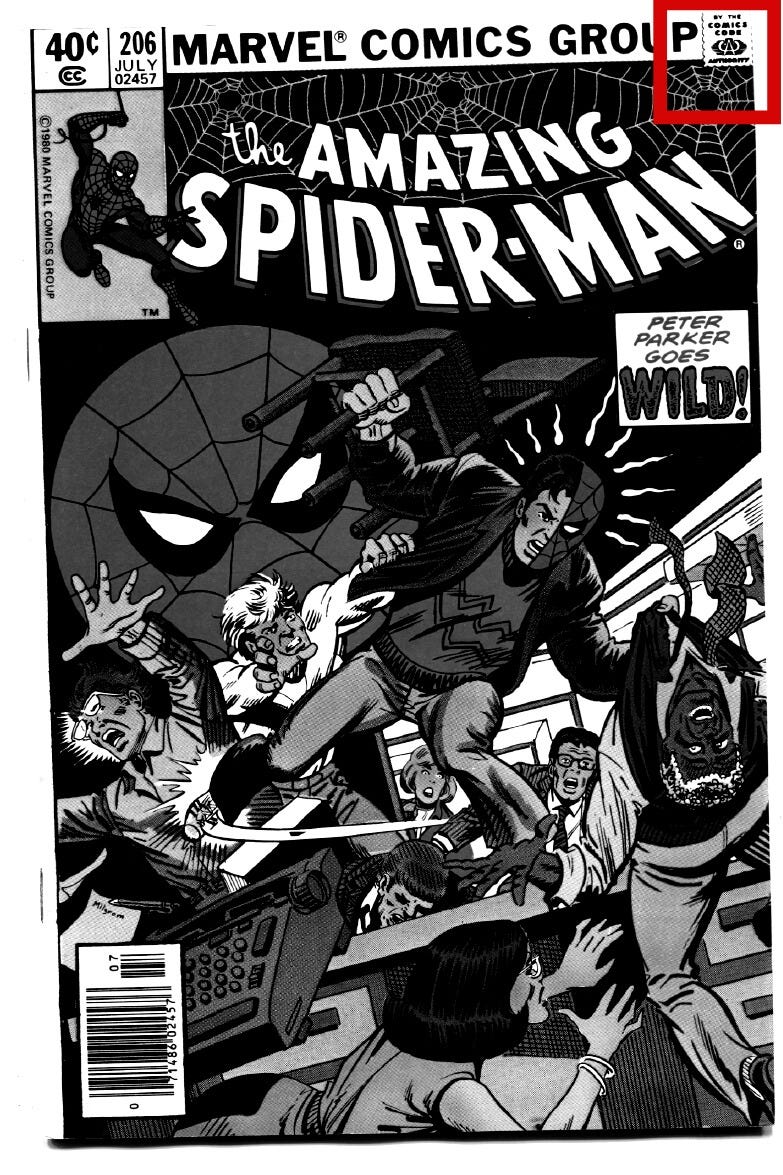
The covers of most American comic books published between 1954 until 2011 carried a small white seal in the upper right corner of the cover with the words “Approved by the Comics Code Authority.” Growing up in the 80s and 90s, I owned and read numerous comics, but I don’t remember giving the CCA seal a second look, which is the point. Seals like that work by being ignored.
The Code came out of a panic. A psychiatrist named Fredric Wertham published a book Seduction of the Innocent in 1954, arguing that comics fed juvenile delinquency. The Senate held televised hearings, and the publishers did what industries facing regulation usually do: they regulated themselves first, before the government could. The Comics Magazine Association of America wrote a list of rules, hired a magistrate to enforce them, and required members to submit their work for approval before printing. Good had to triumph over evil. Police, judges and officials could never be shown in a way that bred disrespect for authority. The words 'horror' and 'terror' were banned from titles, and 'crime' could never stand alone on a cover.
None of it was law. What gave the seal its teeth was the point of sale, the newsstand. Distributors and retailers treated the seal as a condition of carrying a book on their shelves. A comic without it was difficult to distribute, so the rules held for decades even as publishers grumbled about them.
Then comic shops appeared as a competing point of sale. Direct distribution meant publishers could sell to a specialist retailer who did not care about the CCA seal, and the chokepoint that gave the Code its power mattered less. Even so, it took almost four decades from the first direct-market deal in 1973, and more than a quarter century after major titles began shipping without the seal, for the last publishers to walk away. DC and Archie, the last two publishers still submitting for approval, both left in January 2011, and the association that had run the seal for more than half a century folded. In September 2011, the Comic Book Legal Defense Fund, which exists to fight comics censorship, bought the rights to the seal and started licensing it for t-shirts.
Those decades of authority ended when publishers decided the standards body was unnecessary for their business model. This authority, not to be confused with a binding mandate, was lent. When the lenders of that authority started moving on, the authority waned, and then ended.
We are currently in a similar period of change with higher education accreditation in the U.S.
What the Landlord Decides
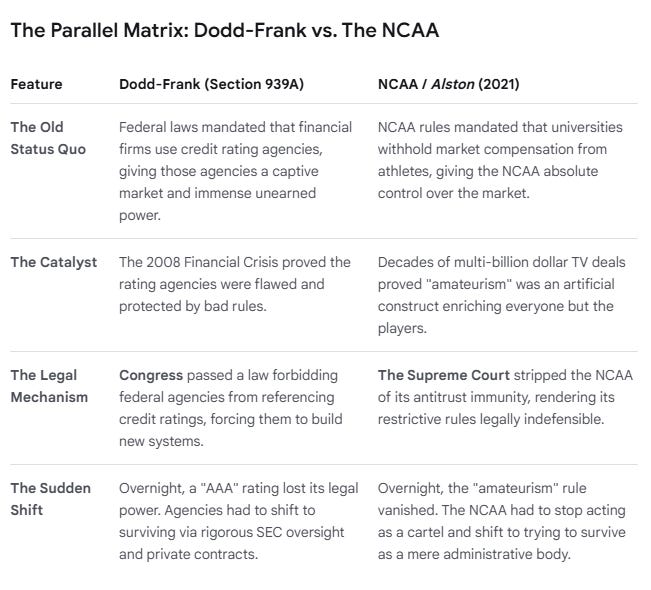
The credit rating agencies are the version where the lending was a mandate. In 1975 the SEC wrote the phrase Nationally Recognized Statistical Rating Organization into its broker-dealer capital rule, and began deciding, one no-action letter at a time, which agencies qualified. Bank capital rules and money market fund rules at the federal level, and insurance capital standards at the state level, all came to lean on NRSRO ratings. These government decisions about who to rely on produced businesses with extraordinary margins and very little competition.
Then the 2008 financial crisis happened, and Congress reconsidered. Section 939A of the Dodd-Frank Act told federal agencies to strip references to credit ratings out of their regulations and find other ways to assess creditworthiness. The credit ratings firms are still there, and the NRSRO designation still exists. But the regulatory mandate disappeared.
Pre-2008, the NRSRO designation existed to grant rating agencies regulatory privileges, acting as a legal rubber stamp for financial institutions. Today, designation survives only as a registration and oversight regime, though the ratings still carry regulatory weight in state insurance rules.
The NCAA got kicked from two directions at once. In 2021, a unanimous Supreme Court held that the NCAA's limits on education-related benefits violated antitrust law, and it refused to give the association's amateurism rules any special deference. Then state legislatures passing their own athlete compensation laws within weeks. No negotiation, no transition period. The NCAA’s counterparties just stopped waiting for it to decide.
On June 30, 2021, with the July 1 state-law deadlines just hours away, and terrified of immediate, multi-billion-dollar lawsuits, the NCAA completely surrendered. On June 30, they passed an “Interim NIL (Name, Image, Likeness) Policy”. They did not create a new system; they simply suspended their own rules. They declared that, effective the next day, athletes could make money off their NIL without losing NCAA eligibility, effectively deferring all rules to a chaotic patchwork of state laws.
Which brings us to today. On September 23, a federal advisory committee meets in Washington, DC to review whether the American Bar Association’s accrediting council keeps its Department of Education recognition as the accreditor of American law schools, after department staff recommended denying it.
On September 8, after suspending enforcement for more than a year, the ABA's accrediting council voted 10 to 6 to repeal Standard 206, its diversity standard. Its chair described the repeal as necessary to keep recognition from state courts and the department. Texas, Florida, Alabama and Washington have loosened or ended their reliance on the ABA. Texas finished in January with a final order that kept every ABA school on its list, and Ohio and Tennessee are reviewing their rules.
The mechanics of this were covered in an intelligence brief published by The Intelligence Council this morning.
The reason this matters outside law is a rule the Department of Education proposed in August. It would require accreditors to operate fully separate from the professional associations they grew out of, sharing no staff, facilities, or operations. It describes how several of the largest professional accreditors are built, including those for medicine (LCME), baccalaureate nursing (CCNE) and veterinary medicine (the AVMA Council on Education).
What’s Left When the Mandate Goes
Three organizations lost the thing that made them mandatory, and the outcomes could not have been more different. The rating agencies still have customers. The NCAA suspended its rules on athletes' name, image and likeness in a single vote. The Comics Code is now a t-shirt graphic. What separates them is whether anyone would have chosen them without the requirement.
For the rating agencies, the answer turned out to be ‘yes.’ The NRSRO designation was a distribution channel for a product that also had independent demand. Banks and asset managers wanted a common language for credit risk, and they still do. Congress closed the channel in 2010 but the product kept selling. It’s an open question whether those inside the arrangement knew which part was the real business until the mandate was gone. Nearly four decades of regulatory privilege had made the two indistinguishable from the inside.
The NCAA got the other answer. An organization with something real underneath does not suspend its defining rule hours before a deadline. It uses the leverage of being genuinely difficult to replace to shape the transition. The NCAA had litigated for a decade and lost, and by June 2021 it had nothing left to bargain with. Amateurism was a rule that existed because everyone had agreed to pretend it did, and the moment the courts and the states stopped pretending, it evaporated overnight.
Which brings us back to the ABA. Under federal and state pressure, it repealed its own diversity standard less than three weeks after an adverse federal staff report, while at least two more state courts were actively reviewing their rules. As a strategic move, it accomplished nothing, because it did not change anyone’s cost of replacing the ABA by a single dollar. What it communicated to every court still deciding is that pressure produces concessions. Meanwhile the thing the ABA actually holds sat undefended and largely undiscussed. Every accredited law school is required to publish standardized data on cost, attrition, bar passage, and employment outcomes, and that dataset is the only comparable national picture of American legal education. Texas was able to reclaim approval authority in a single order precisely because it did not have to rebuild any of it. Fifty states generating comparable data independently would produce an expensive, inefficient mess. The ABA conceded on a standard, while the asset that would make it expensive to replace went unmentioned and unleveraged.
A company that has lived inside a mandate long enough sometimes stops seeing it. The revenue is real and customers renew. The strategic plan has boxes for growth, margin and product, and none of them is labeled “the regulation our business model depends on.”
The rating agencies came through 2010 with their business intact because, somewhere in the preceding decades, they had built something investors wanted for its own sake. It was a shared language for credit risk. Asset managers wrote it into their own investment guidelines, and bond buyers used it to price debt, with no regulator requiring either. Whether the agencies built that deliberately or it simply accumulated, it was there when the mandate left.
An incumbent doesn’t have to wait for a rule change to find out what it has. It can learn now which of its revenue is chosen and which is required, and the work comes in three parts.
The first is to name who grants the position. It might be a statute, a regulator, a professional body, a few state courts, or a handful of large buyers whose procurement rules name you specifically. Then estimate how fast that party could change its mind. The Comics Code had nearly four decades between the first direct-market distribution deals in the early 1970s and the day the last publishers walked out. The NCAA, after a decade of losing in court, ended up with a deadline measured in hours.
The second is to go through the revenue line by line and ask whether each customer would still buy if the rule disappeared tomorrow. The cleanest evidence comes from wherever the product already sells beyond the rule’s reach, to customers with no obligation to buy it. If it wins there at a similar price, that revenue is chosen. If nobody has ever checked, assume the answer is less flattering. The Comics Code in 1992 still looked like the gatekeeper of the industry, while the biggest publishers were already selling to shops that did not care about the seal.
The third is to be strategic about investing where the ‘chosen’ revenue lives. For the rating agencies, that meant the analysis and the benchmark itself. For the ABA, it is the standardized dataset that fifty states would struggle to rebuild. When pricing, based on customers’ willingness to pay, reflects what the customer gets from the product, it tends to hold through a rule change.
The rating agencies found out what they had in 2010, when Congress ran the test for them. Every organization sitting on a mandate may eventually be tested in a similar way. The choice it has is whether to run the test first.
Adil Husain is the Founder and Editor-in-Chief of business media company The Intelligence Council, and Managing Director of the global advisory firm Emerging Strategy.