

TLDR
As content becomes cheap and instructional delivery increasingly automated, the traditional value proposition of in-person undergraduate education must be redefined. This article introduces a 5-part framework: Formation, Community, Signal, Experience, and Alignment, to evaluate what remains defensible in a high-cost degree. It outlines practical implications for university leaders, EdTech companies, and investors, and makes the case that the future of higher education lies not in resisting change, but in delivering what technology cannot replicate: structure, standards, judgment, and trust.
A Silent Shift With No Clear Strategy
In many classrooms today, students submit assignments they’ve drafted with machine assistance, and receive feedback their professors generated the same way.
Faculty use AI tools to outline lectures, prepare reading summaries, and draft preliminary comments on student work. Students use AI tools to conduct research, organize ideas, develop responses, and receive feedback before anything is submitted. This dynamic now shapes how learning occurs inside the classroom and how performance is evaluated. In some classrooms, this happens openly. In others, it’s unspoken but understood.
Despite this shift, many colleges have not meaningfully changed how they define, price, or deliver the undergrad academic experience. Most continue to emphasize content access, course libraries, and branded instructional platforms. Education technology vendors still prioritize scale and integration over substance. Investors tend to reward automation models that promise cost reduction rather than improved outcomes.
Yet the core problem is not technical. It is strategic.
The tools have changed. The institutional operating models largely haven’t.
The market no longer values content in the same way, but higher education continues to treat it as the foundation of its product.
This raises a fundamental question:
If instructional content is widely accessible and rapidly produced, what remains defensible in the traditional, high-cost college experience?
Many institutional leaders know the answer to this intuitively.
But very few are intentionally building strategy, operations and communication around it. The result is a widening gap between what colleges quietly rely on to justify their value—and what they publicly emphasize, measure, or invest in.
The Erosion of Content as Value
For years, undergraduate instruction has been delivered in formats that were already beginning to lose relevance. Large lectures, generic assessments, and platform-based course delivery were common before the recent wave of new tools emerged. In many cases, these models were adopted for reasons of scale, not effectiveness.
Now, most core materials: lecture notes, explanations, readings, and study aids, can be replicated at little or no cost. In some areas, alternatives are clearer, faster, and easier to use than institutional systems.
Students are aware of this. So are faculty. So are many employers.
The real surprise is how little this awareness has changed the core undergraduate academic product.
This article is not implying that higher education no longer matters. It suggests that the academic model built around content delivery is no longer sufficient on its own.
The long-term value of an undergraduate education was never meant to rest solely on access to information. Its relevance depended on something more difficult to quantify: who students become, what they can do, and where the experience leads them.
The challenge now is to make that implicit value explicit, and to structure it in ways that justify continued investment.

The 5 Levers of Defensible Value in Higher Education
The future of the ~$0.5 million in-person college experience depends on institutions delivering something else: something more lasting, more specific, and more difficult to reproduce outside a structured academic environment.
At Emerging Strategy we’ve developed a practical framework to evaluate and strengthen the parts of the in-person undergraduate experience that continue to carry long-term value.
These are not aspirational qualities. They are operational levers and each one reflects a function that universities perform when they are at their best—and each one, if neglected, becomes a source of risk.
You could think of these as the five non-exportable assets. They don’t travel well outside of strong programs, but they’re what still justify a premium.
In my work with education companies, institutional leaders, and investors, I focus on helping them evaluate and strengthen these five levers especially as their traditional models are under pressure. Whether the goal is repositioning a degree, refining a product, or making a program strategy defensible in the market, the work begins by clarifying what still drives trust, outcomes, and long-term value.
1. Formation
The structured development of thinking, communication, judgment, and maturity.
This includes written and verbal expression, ethical reasoning, and the ability to interpret information and act under uncertainty. It is reinforced through courses and learning models that involve discussion, iterative work, and real feedback. It is weakened when instruction is limited to recorded lectures, multiple-choice assessments, and pre-scripted feedback flows. If a student can earn an ‘A’ without ever being asked to revise, reflect, or explain their thinking aloud, the system is signaling the wrong thing. Fewer large lectures and more seminar-style learning.
A recent survey of HR leaders and early-career employees sponsored by Hult International Business School reveals a need for “undergraduate programs focused on developing ‘human’ skills, like communication and collaboration” to address the gap in workplace readiness.
Does the program ask students to think clearly, argue well, and explain their reasoning—in writing and in speech?
2. Community
The student-faculty relationships and peer networks that shape professional direction and personal growth.
This includes informal accountability, study partnerships, shared ambition, and support systems that extend into the early career years. These relationships form naturally in high-contact, in-person programs, and are reinforced through group work, cohort structures, mentoring, and shared experience. They are harder to build in asynchronous, transactional formats. Most institutions talk about belonging. Few effectively resource it.
According to Inside Higher Ed’s Student Voice Survey, “data indicates that students trust professors most…” Universities must lean into that more, and learn to tell that story better.
Can students name at least three relationships they formed during the program that meaningfully shaped their future path?
3. Signal
The institution’s role in certifying readiness to employers, graduate programs, and the public.
Degrees still carry weight in hiring and admissions decisions, but that weight now depends on what the credential signals about quality, standards, and selectivity. When institutions lower academic expectations or replace substantive evaluation with broad participation, they reduce the value of the signal. When they maintain rigor and communicate expectations clearly, the signal holds.
According to employer research commissioned by the Association of American Colleges and University (AAC&U), liberal arts skills are valued and sought out in the workplace but employers question student preparation.
Would a hiring manager or graduate admissions committee choose this program’s graduates over someone without a degree but similar technical skills? And if not, is the institution prepared to explain why they’re still worth the price?
Some lessons can be reviewed. Others have to be lived.
4. Experience
The environment in which students practice applying ideas under pressure, with consequences and context.
This includes live discussion, feedback that isn’t scripted, the discomfort of being challenged, and the process of revising one’s view based on evidence. It’s time the Oxford tutorial model became widely adopted in the U.S. It’s currently limited to a few selective liberal arts colleges such as Williams and Sarah Lawrence.
Throw late-night discussions, group debates, public presentations, and moments of uncertainty that require resilience. These elements cannot be simulated with slides and quizzes.
For all the talk of “real world readiness,” there is still no substitute for navigating a problem live, in a room, with peers who disagree.
Do students leave the program with a clear memory of having worked through difficult, unstructured problems that forced them to adjust?
5. Alignment
The degree to which a program’s structure, expectations, and outcomes reflect what students are actually trying to achieve, and what the job market, graduate programs, or other downstream paths require.
According to employer research commissioned by the AAC&U, "Completion of active and applied learning experiences gives job applicants a clear advantage." Meanwhile Strada Education Network’s student research indicates “Most students (70 percent) report that they were motivated to participate in an internship to gain experience in a specific career that they plan on pursuing as their chosen profession."
Alignment is not about merely offering job training. It’s about designing programs that make sense to students given their goals, and that hold up under scrutiny when evaluated by employers or selection committees. It includes:
Ensuring program content matches the skills, knowledge, and decision-making frameworks students will need in their next step.
Making course sequencing, degree requirements, and academic expectations transparent and coherent.
Providing clear pathways to internships, research, or applied projects that connect learning to future use.
Actively incorporating employer and alumni feedback into curriculum design and advising.
If the student sees no visible connection between their degree path and their intended path after graduation, they will rightly ask: What exactly am I doing?
If a student were asked six months after graduation whether the program prepared them well for their next step, would they say yes, without hesitation, and be able to explain why?
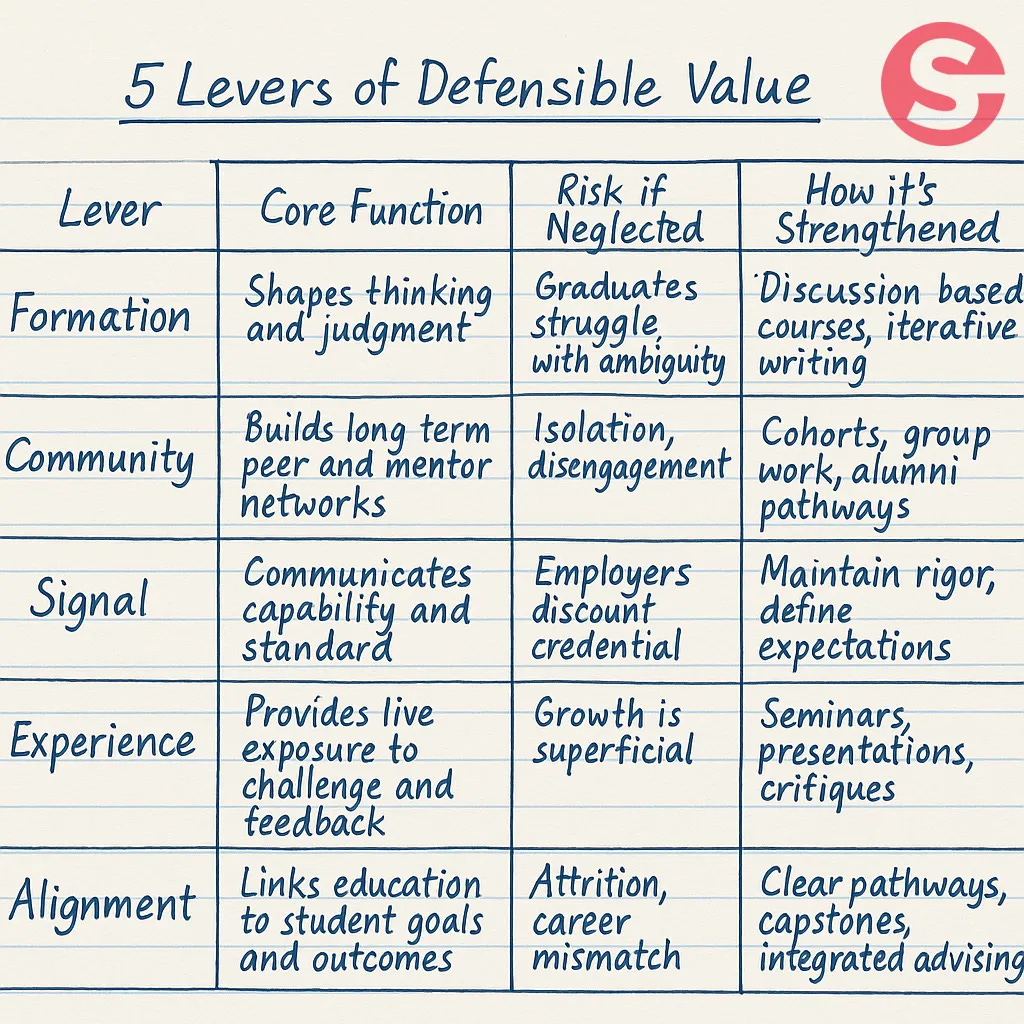
The most resilient institutions will be those that treat these five levers not as branding themes, but as operational priorities.
What Holds, and What Comes Next
The institutions that will endure are those that stop trying to defend instructional content as their core product. That phase is over. Content can now be generated, distributed, and accessed across multiple channels with little cost and minimal friction. This is not a future scenario. It is already the case in most classrooms, regardless of whether faculty or administration have formally acknowledged it.
The relevant question is no longer “How do we teach?” It is “What remains worth delivering in person, with care, at full cost?”
The answer lies in five areas:
Students still want to be shaped by serious intellectual work.
They still want to belong to something that outlasts the transcript.
They still want credentials that carry real weight.
They still want to be challenged, in real time, by people they respect.
And they still want a clear link between the work they do and the life they want to build.
These are not sentimental ideals. They are practical, measurable, and achievable—but only if institutions choose to orient around them deliberately.
In the past, these outcomes were treated as the byproduct of enrollment. Now, they must be treated as the product itself.
Colleges that adjust their operating models accordingly will stabilize. Those that don’t will spend the next decade in a cycle of price discounting, retention decline, and reputational drift. The same is true for technology providers and capital partners. Success in this space will not come from doubling down on efficiency. It will come from helping institutions deliver what students, employers, and society continue to need—an environment where people learn to think, grow, and decide with clarity and accountability.
The strongest institutions will not be those that resist new tools. They will be those that integrate them without losing sight of what makes their work matter.
That is the future of the $80,000 classroom. Not as a delivery vehicle. But as a place where knowledge is tested, character is formed, and real preparation happens—under pressure, with support, and in full view of others.
Adil Husain has over two decades of experience advising education and learning organizations within the K-12, Higher Education and Workforce/Professional space, including leading universities and 13 of the 20 largest U.S. education companies by revenue, on corporate strategy, product-market fit, customer acquisition, and growth. He is Managing Director at Emerging Strategy, a strategic intelligence firm that helps enterprises within Education and other sectors find clarity in chaos.
You can contact Adil here directly, or connect with him on LinkedIn.
Related Articles:
the enemies who trade

Taiwan exported $100 billion worth of goods to China last year. A country that surrounds it with warships, flies fighter jets across its airspace, and refuses to recognize its political existence is also its top trading partner.


Appreciate the thinking on this model thinking, how did you arrive here and is there anything you're still wrestling with given the model? I will have to ruminate more, but Formation on it's own really hit me as an aha - Thank you!