

It started, as these things often do now, with a post.
Elon Musk, fresh off a stint as a high-level advisor in Donald Trump’s second administration, took to his own platform to declare the president’s signature domestic policy bill a “disgusting abomination.” Trump, characteristically, responded by threatening to strip Musk’s companies of billions in government contracts. By lunch, Musk had unfollowed two of Trump’s most visible allies—Stephen Miller and Charlie Kirk—on X, while Kirk was mid-livestream praising the very bill Musk had just torched.
That’s how fast things move now. One week you’re being lauded in the Oval Office as a visionary industrialist, and the next you’re digitally ghosted by the guy you helped elect.
The breakup was inevitable. But the choreography was exquisite.
We’ve grown accustomed to watching alliances fracture in public. But this one is different—not because of who’s involved (though there’s no bigger soap opera than Trump + Musk), but because of how it unfolded. Not through an op-ed. Not through a leak. Not even through a press conference.
It happened through follows and unfollows. Through memes and timestamps. Through that strange grammar we’ve all come to understand, even if we pretend not to: the performance of political rupture through the tools of adolescent social media.
And yet—beneath the spectacle—something instructive is happening.
Because if you can get past the absurdity, there’s real signal here. Not just about the antics of two powerful men, but about how power communicates now. What it hides. What it reveals. And what it means when someone with billions in government contracts decides the loudest thing he can do… is unfollow.

The Adolescent Playbook at Scale
There’s a moment in middle school when the social order starts to be governed not by conversation, but by attention. Who looks at whom. Who likes whose post. Who suddenly disappears from your followers list.
This is the language of adolescence: passive-aggressive, perfectly deniable, and instantly legible to everyone involved.
Which is why it’s so uncanny to watch Elon Musk operate.
He doesn’t behave like a seasoned political player. He behaves like a chronically online teenager. One who owns the app.
When he’s happy, he posts memes of approval. When he’s angry, he reposts screenshots of old praise and annotates them with sardonic captions. When he wants to break ties, he unfollows—publicly, precisely, and at maximum visibility.
He understands that in the digital age, a clean break isn’t a press release. It’s a vibe shift. It’s the absence of engagement where it once existed. It’s the conspicuous silence that everyone rushes to interpret.
Trump still plays the Boomer game of presence—statements, threats, spectacle. Musk plays the Gen-Z game of absence.
And when Musk unfollowed Charlie Kirk and Stephen Miller, it wasn’t a tantrum. It was a preview. A tactic.
Because on the platforms Musk dominates, attention is currency—and the withdrawal of it is power.
My House, the Front Lines
I didn’t learn this from Musk. I learned it from my daughters.
By the time they were in middle school, they had already internalized what Elon is now demonstrating on the world stage: that social standing is managed through visibility. That silence can sting more than confrontation. That to unfollow is to declare the relationship over—without the burden of saying it aloud.
I've watched them navigate this terrain with a kind of tactical fluency. One evening, one of them walked in quiet and tight-lipped, shoulders curled inward. She hadn’t been bullied. She hadn’t been insulted. She’d been removed from someone’s Close Friends list on Instagram.
She knew instantly. So did her classmates. It was a signal: You’re no longer someone I want seen beside me.
I remember trying to downplay it. “Maybe it was a mistake,” I offered.
She looked at me, deadpan: “No, Baba. You don’t get it.”
And she was right. The ecosystem she was growing up in had its own signals, its own consequences, its own hierarchy of meaning. These weren’t kids being dramatic. They were becoming literate in a language that adults still treat as trivial.
Which is why it doesn’t surprise me when Musk, cornered and vengeful, doesn’t call a press conference—he unfollows.
Because for all his billions, all his satellites and senators and stock tickers, he’s using the same playbook my daughters mastered in eighth grade.
The Feed as Intel
This isn’t just theater.
When Elon Musk unfollows Charlie Kirk, it’s not a teenage mood swing. It’s a deliberate signal: read and interpreted in real time by millions, including lawmakers, investors, and corporate leaders. It’s a change in alignment. A public severance. A redrawing of loyalties using the tools of digital intimacy.
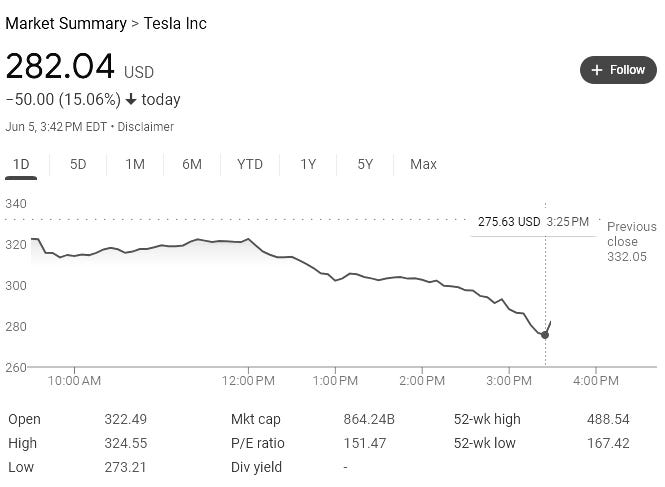
Tesla lost over $100 billion in market capitalization today once the Musk–Trump spat became public. Would advance intel of Elon’s social media unfollows have helped someone time their trades?
If you’re in the business of power—whether political, financial, or strategic—you should be watching closely.
Because in a world where communication is constant, the most revealing signals aren’t what people say. They’re what people stop saying. Who they stop following. Whose posts they no longer like. Whose names disappear from retweets, taglines, panels, podcasts, funding rounds, and press junkets.
These shifts aren’t random. They’re predictive.
You can map the crumbling of partnerships, the formation of rival camps, the quiet snubs that precede boardroom coups or political betrayals—if you know where to look.
We map this for clients every day—quiet shifts in attention, alliances, and influence that won’t show up in the usual dashboards. But once you learn to track the feed, you start seeing everything differently.
Forget leaks. Forget anonymous sources. Forget half-baked analysis on cable news. If you want to see what’s coming, watch the feed. Watch it change.
Because follow behavior, mute behavior, and silence—especially when it deviates from a previous pattern—aren’t just noise.
They’re early-warning systems in plain sight.
Reading Between the Lines (and the Likes)
This isn’t about Elon Musk. Or Donald Trump. Or even adolescent girls navigating social hierarchies.
It’s about all of us.
It’s about the new language of power: one built less on declarations than on disappearances. Less on what you publish, more on what you withhold. In this language, unfollowing isn’t petty. It’s tactical. A subtle form of withdrawal that can shift the mood of a market, the posture of a party, or the balance of a boardroom.
I've spent the past two decades helping organizations navigate complex, cross-border dynamics—but the digital layer of power is the most under-analyzed. That’s where so many blind spots hide.
For years, we treated social media as noise—too emotional, too performative, too unserious to matter in real strategy. But what if it’s the opposite? What if the performance is the strategy?
The truly plugged-in aren’t just reading what leaders post. They’re watching who else engages. Who disappears. Whose allies shift. Who starts retweeting competitors. Who stops posting altogether.
That’s where the signals are.
In my house, these are life skills. For my daughters, social fluency means understanding the implications of a like, the choreography of group chats, the significance of being left out of being tagged in a post. It’s part of how they navigate the world. They don’t roll their eyes at the unfollow. They analyze it. They know it means something.
Maybe we should too.
Because in a world saturated with content, intelligence doesn’t always arrive as a whitepaper. Sometimes, it arrives as a sudden silence. A missing name. A relationship that used to be visible… and no longer is.
If you're not already reading the silences, you might be missing the real conversations. I work with leaders who want to change that.
There’s no press release for an unfollow.
But that doesn’t mean it goes unnoticed.
Adil Husain has over two decades of experience advising Fortune 1000 firms on strategy, market intelligence and global expansion. Having lived and worked in the U.S., and China for a decade each, he brings a unique perspective on how U.S. businesses can best succeed both domestically and internationally. Adil is the Managing Director of Emerging Strategy, a global strategic intelligence firm that helps enterprises navigate complex markets.
You can contact Adil here, or connect with him on LinkedIn.
the invitation that never comes

We were sitting around the room in Austin last week—eight men, all founders, all somewhere between forty and sixty. No one was trying to outshine anyone. That’s the quiet magic of our annual retreat.
the men who know me

There are eight of us. We’re founders. All men. All somewhere between forty and sixty. Scott is old. We keep reminding him. And for one week each year, we agree to be together.
